Coolant circuit and engine cooling
WIS 20-005
Coolant circuit
Warming-up period
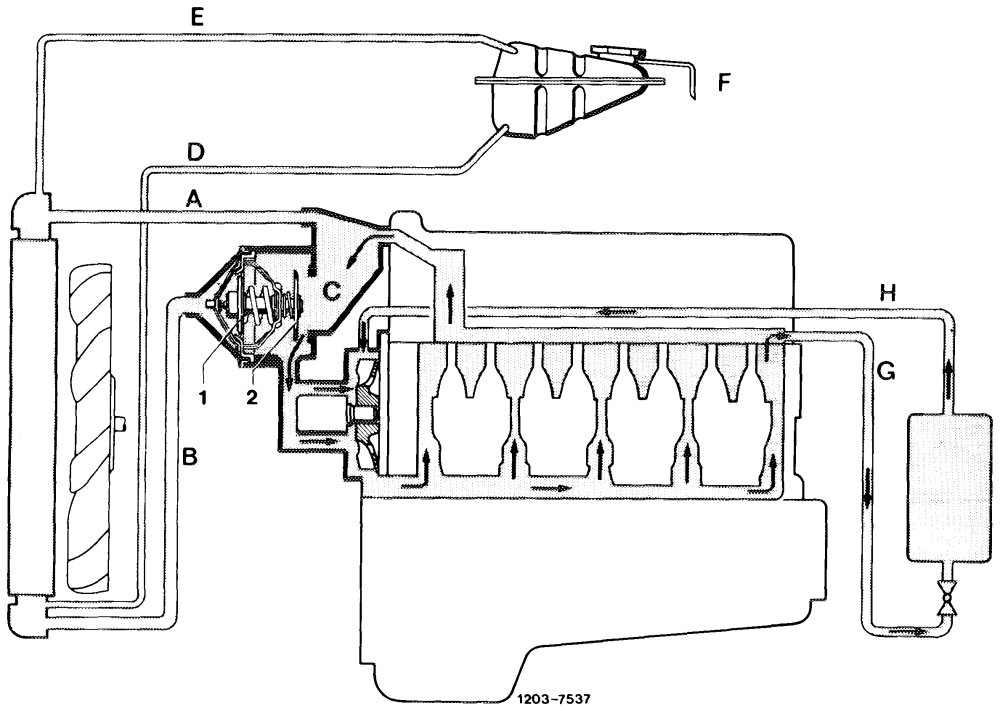
Main valve (1) closed, bypass disc (2) fully opened. Coolant temperature < 75 °C.
Bleed line onNwp From engine to radiator zZamm Overflow hose From radiator via thermostat to engine From engine to heater Bypass Heater water return line Feed, expansion tank — radiator
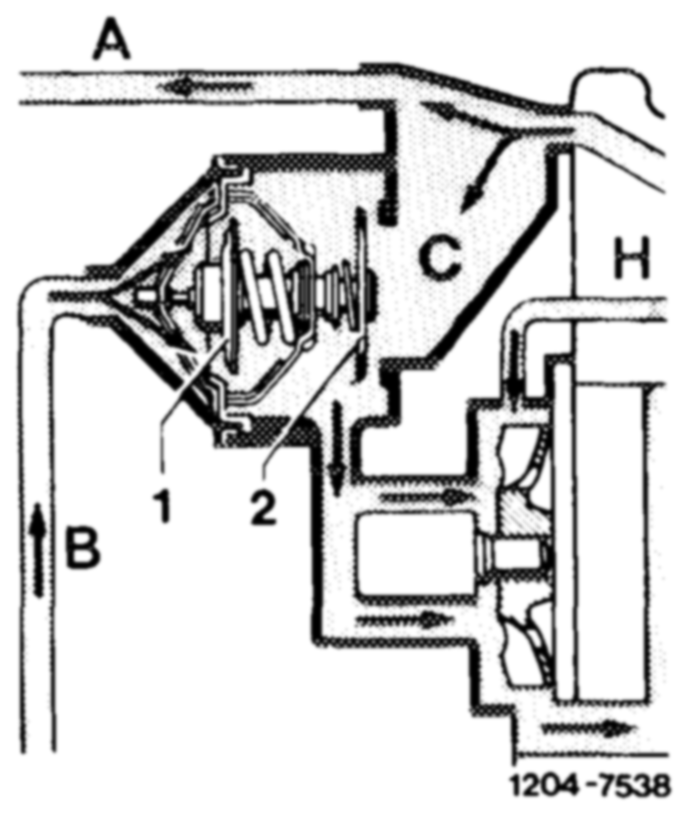
Operation at partial load
With the engine at operating temperature, the main valve (1) as well as the bypass disc (2) are more or less open depending on engine load and ambient temperature. The coolant is guided both through radiator (A) as well as bypass (C) depending on thermostat position.
Full-load operation — high ambient temperatures
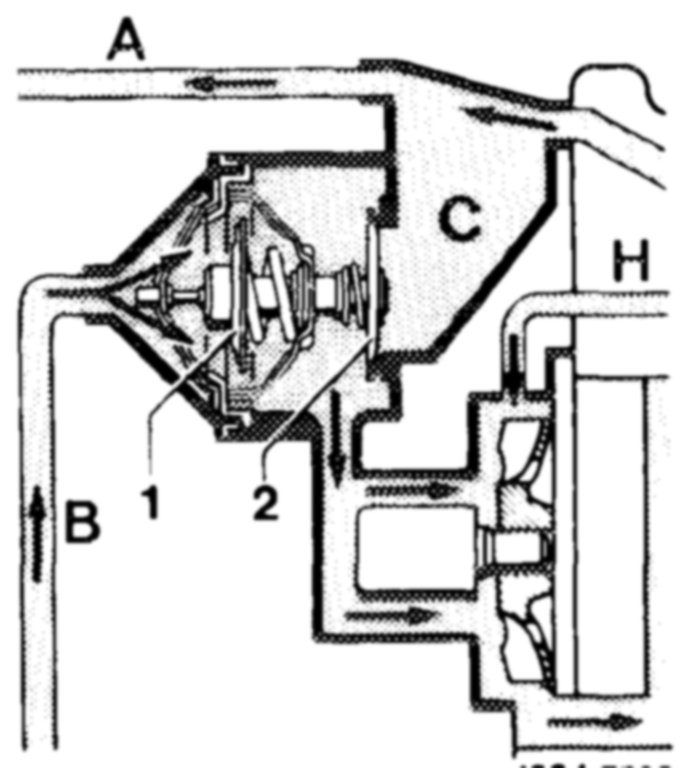
Main valve (1) fully opened. Bypass disc (2) closed.
At high engine load and high ambient temperatures the bypass (C) is closed. At the latest at 95 °C coolant temperature. All the coolant should flow through radiator. It is therefore wrong to remove the thermostat for ‘better’ cooling of engine.
Engine cooling
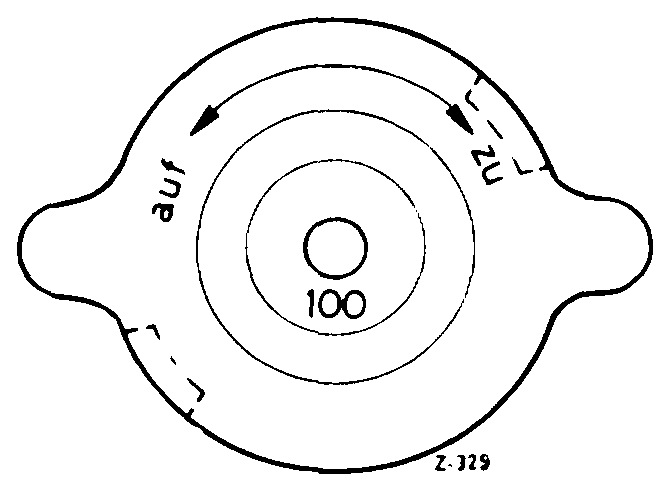
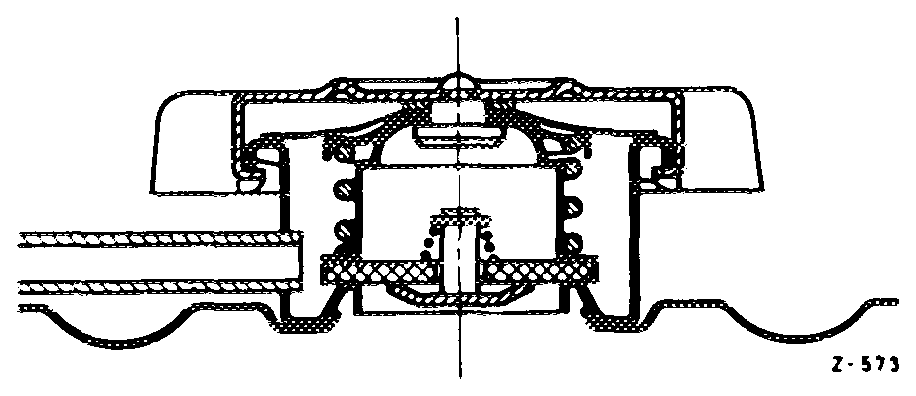
The spring-loaded radiator cap (code No. 100) establishes a gauge pressure of approx. 1 bar in cooling system.
The cooling system is filled ex factory throughout the year with a coolant which comprises approx. 55 % by volume of water and 45 % by volume of antifreeze.
This will guarantee protection against freezing up to —30 °C, while additives in anti-freeze will prevent corrosion in cooling system. Since the additives are subject to ageing, the coolant should be renewed every 2 years.
As a protection against corrosion, the concentration of the anti-freeze should not drop below 30 % by volume (—20 °C anti-freeze).
Attention! Use only anti-freeze compounds approved by us to prevent damage to light alloy components.
If no anti-freeze is available and only water is filled in, make sure that 1 % of a treating agent (anti-corrosion oil) (10 cc/I water) is added.
The anti-freeze will increase the boiling point for water amounting to approx. 118 °C at 1 bar gauge pressure to approx. 125 °C for the mixture filled in at the factory.
The red mark on telethermometer begins at 122 °C, prior to middle of 1975 at 115 °C.
This point must be given special attention, when only water with a treating agent is filled in. In such a case, water may be ejected before the indicator of the coolant thermometer arrives at the red mark.
At full load, while driving uphill and bumper-tobumper, after fast driving on expressways with a subsequent vehicle congestion, or while driving in areas with high ambient temperatures, the coolant temperature indicator may rise up to red mark, protected by the anti-freeze up to min. —30 °C, without
any ejection of coolant or irregular engine perform-
ance.
During extended stationary operation, e.g. ina traffic congestion, moving the selector lever into position ‘’N“ will be of advantage for vehicles with automatic transmission. The heat generated in the transmission and consequently the additional heating of the coolant will be reduced via the transmission fluid cooler.
If coolant is lost through leaks of cooling system or through ejection as a result of overheating, a pertinently treated coolant must be added. Losses caused by evaporation can be topped up with tap water.