Testing cylinders for leaks
WIS 01-0150
Operation no. of operation texts and work units or standard texts Preceding work: per pe Ay cleaner removed (09-1051). ane a gates
Data
| Total pressure loss | max. 25 % |
| At valves and cylinder head gasket | max. 10 % |
| At pistons and piston rings | max. 20 % |
Commercially available tools and testers
Designation eg. make, order no. Cylinder leaktightness tester eg. Bosch, EF AW 210A Sun, CLT 228
Testing
1 Run engine until it is at normal operating temperature.
2 Blow out recesses of spark plugs with compressed air.
3 Remove spark plug (15-1031).
4 Top up coolant and leave filler opening at coolant expansion tank open.
5 Take off oil filler cap.
6 Connect cylinder leaktightness tester to a compressed air system and calibrate tester.
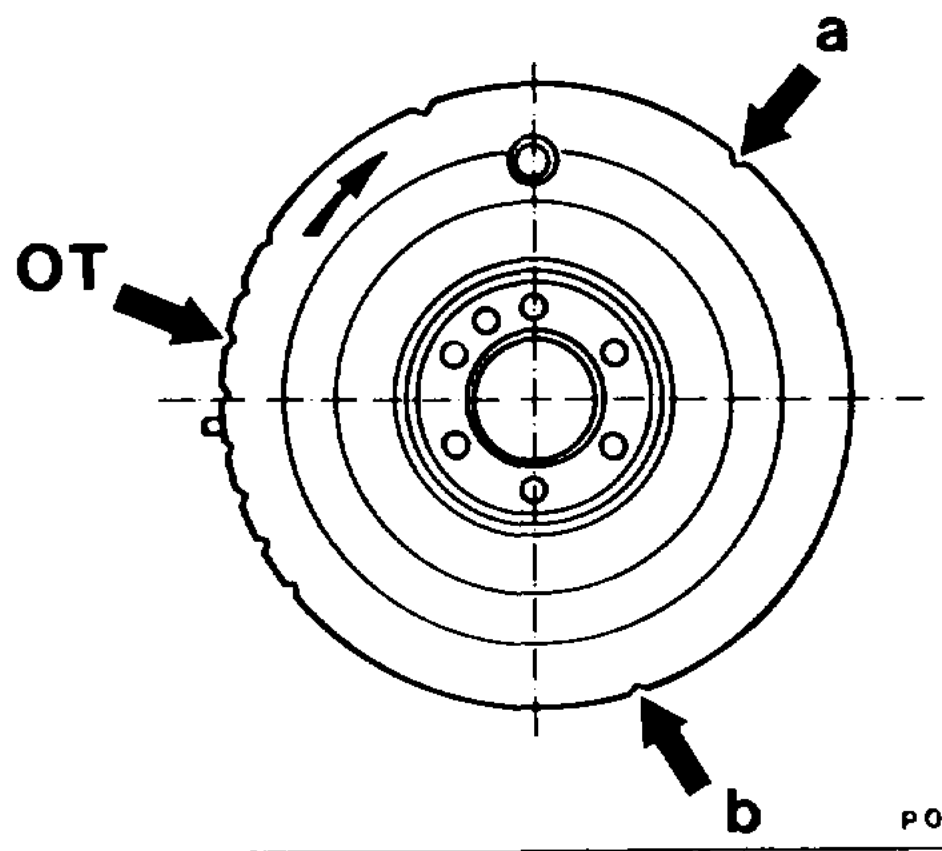
7 Position piston of cylinder 1 to ignition TDC.
Note The respective pistons are at ignition TDC or in TDC position if the markings shown in the drawing opposite (arrows) on the vibration damper are aligned with the TDC pointer.
P01-0098–13
we RA 01.1113-0150/1
| Marking | TDC | b = 120° | a = 240° |
| Piston at TDC at cylinder | 1 and 6 | 2 and 5 | 3 and 4 |
8 Screw connection hose into the 1st spark plug hole, fit on connection hose of tester and pressurize compression chamber (approx. 5 bar). The crankshaft must not move when performing this step.
9 Take reading of pressure loss on tester (in %).
10 Fully open throttle valve.
11 Listen to determine whether the pressure escapes through inlet manifold, exhaust, oil filler opening, spark plug hole of adjacent cylinder or coolant filler opening.
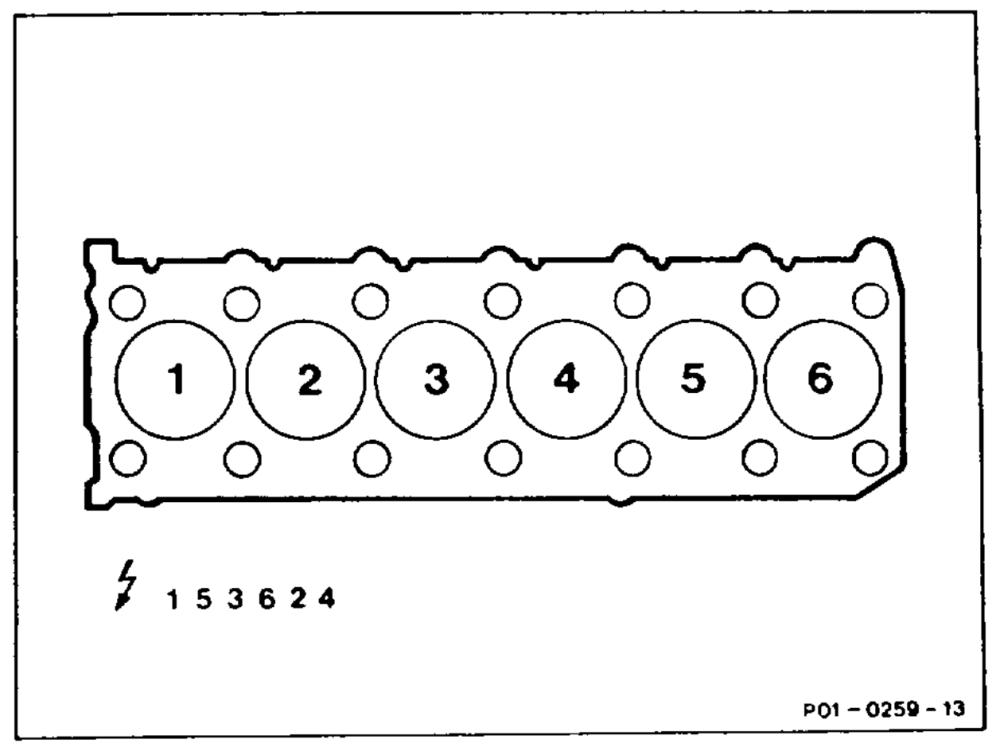
12 Test all the cylinders in the firing order (1-5-3-6-2-4).
Note
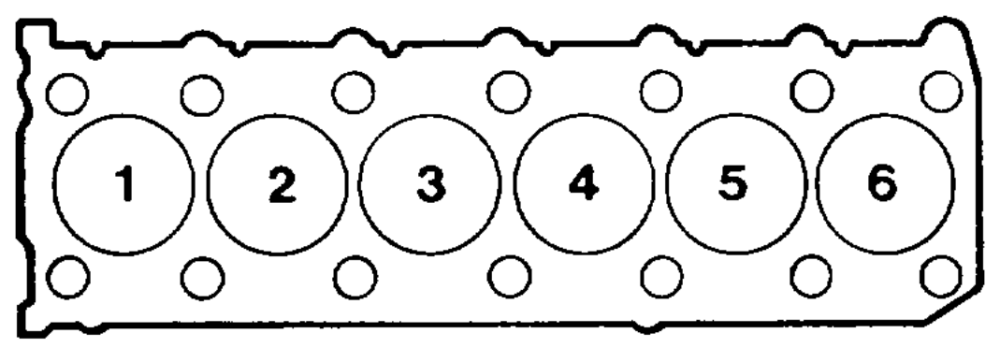
After spraying oil onto the piston crown, it is possible to determine whether the leak exists at the piston rings or at the valves, or at the cylinder head gasket.