Types 300 - 300 d (W 186, W 189)
Production: 1951 - 1962
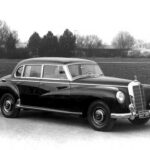
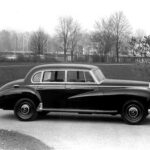
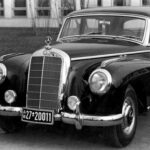
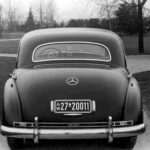
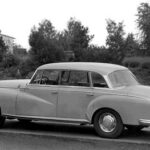
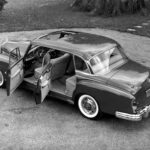
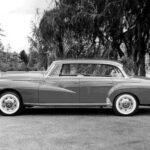
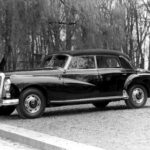
Types
| Type | Model | Production | Number produced |
|---|---|---|---|
| 300 | W 186 II | 04.51/11.51 - 04.54 | 4.563 saloons, 2 chassis |
| 300 Cabriolet D | W 186 II | 04.51/03.52 - 04.54 | 455 |
| 300 b | W 186 III | 03.54 - 08.55 | 1.639 saloons, 10 chassis |
| 300 b Cabriolet D | W 186 III | 04.54 - 08.55 | 136 |
| 300 c | W 186 IV | 09.55 - 07.57 | 1.367 saloons, 3 chassis |
| 300 c Cabriolet D | W 186 IV | 09.55/12.55 - 06.56 | 51 |
| 300 c with elongated wheelbase | W 186 IV | 05.56-07.57 | 62 |
| 300 d | W 189 | 08.57/11.57 - 03.62 | 3.073 saloons, 1 chassis |
| 300 d Cabriolet D | W 189 | 07.58 - 02.62 | 65 |
| 300 d with elongated wheelbase und erhöhtem Dachaufsatz | W 189 | 12/60 - 02.61 | 1 saloon, 2 Landaulets |
History
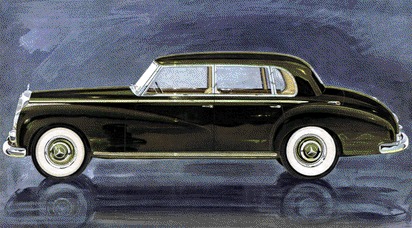
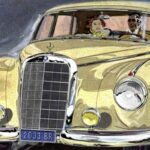
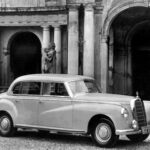
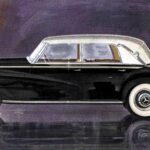
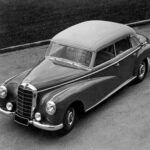
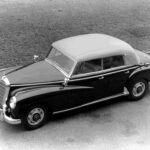
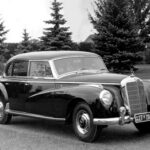
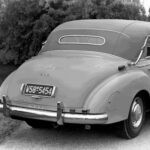
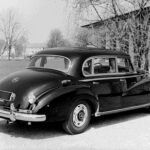
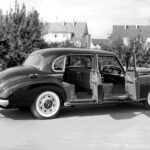
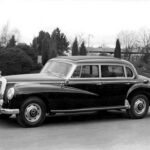
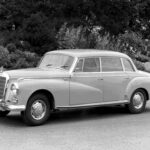
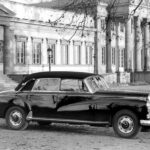
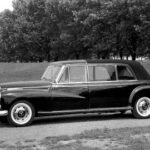
At the first international automobile fair in Frankfurt, which took place six years after the war in April 1951, many novelties were presented, including some cars of the top class. Apart from the 220 model, Daimler-Benz unveiled another new design, which was even more popular with the public: the 300 type, the biggest and fastest serial car of German production of its time. This soon became the favourite car for representative purposes in politics and in industry. We can justifiably desribe it as the true successor of the ,big mercedes" of the pre-war era, even though it was never officially described that way. Among the first important personages, who were chauffered in the 300 model were Konrad Adenauer, Theodor Heuss, Finance minister Ludwig erhard and Kurt Schumacher, to name only a few.
The reason why the 300 model was first and formost linked with the name of the first chancellor of the Federal Republic of Germany and why the people and fans of vintage cars call it the ,Adenauer-mercedes", is the fact that the ,der Alte" (the old chancellor) would never be chauffeur-driven in anything else but a 300 model, even when he was travelling abroad. During his term in office as federal chancellor until 1963 and then until his death in 1967, Adenauer had had six different 300 models. His first official car from 1951 is exhibited today in the "Haus der Geschichte" (house of history) in Bonn. the 300 d model of 1959, however, which Adenauer used after his retirement, moved into the ownership of Daimler-Benz and is on show in the Mercedes-Benz museum.
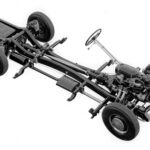
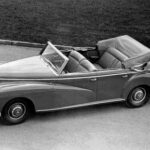
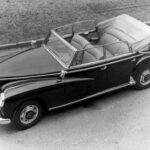
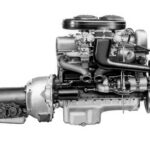
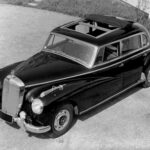
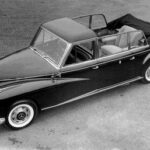
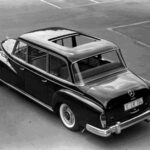
Like the 170 S model, the 300 model, too, is not purely a post-war construction. Technically, as well as conceptually, its roots go back to the 260 model of 1940, which did not move into serial production, because the war interfered. Like the 220 model, The 300 was powered by a six-cylinder engine with overhead camshaft. In its first version it delevered 115 bhp and reached a maximum speed of 160 km/h. framework and chassis basically followed the concept of the 170 S and 220 models, but were adjusted to the higher weight and remarkable driving performance of the 300. The most important novelty was an electrically connected torsion bar suspension. Under extreme loads - the upper limit was 365 kg at first - this acted as a levelling device for the rear wheels. Apart from the saloon car, which was available with optional sun-roof if desired, there also was a five- or six- seated convertible. Production of the main series was launched in November 1951, after the preserial cars had been externsively tested.
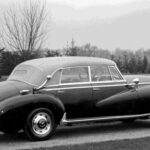
In May 1954, the first model revision package was under way. The improved version, internally called 300 b, had a more powerful 125 bhp engine with a higher compression and was fitted with broader brake shoes as well as a vacuum servobrake. Externally, too, some details had changed: the 300 b had knockout windows at the front doors, protective chrome mounting against stones at the rear mud guards and fender attachments at the rear and front fenders.
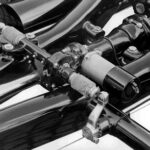
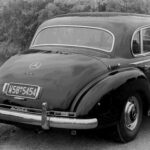
In September 1955, at the third IAA (International Automobile fair) at Frankfurt, another modified 300 model was on display. The new model, internally called 300 c, could be recognised by its enlarged rear window and broader tyres. the profound changes, which had been undertaken were not visible on its exterior: Together with the 180 and 180 D models, the 300 c had received a single-joint cross shaft axle, guaranteeing better ride quality. Moreover, it was now available with automatic shift gear as special equipment, which had not been developed by Daimler Benz, however, but was supplied by Borg-Warner. This so-called "Detroit-Gear"-Automat was executed as a hydraulic torque converter with two secondary planet gears and an integrated single-disk clutch for the direct gear.
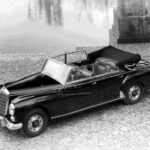
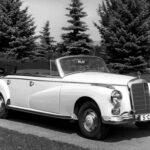
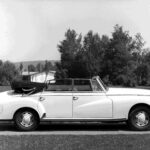
Like its predecessors 300 and 300 b, the 300 c model was available with a sliding sunroof and/or bulkhead if desired and could moreover be supplied as a four-door convertible D. In order to ensure a more unified production and because demand was low, the convertible was taken out of the sales programme in April 1956 and produced only until June 1956.
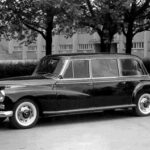
a longer special design of the 300 c, was produced and delivered to the federal Chancellor's office after the chancellor had expressed such a wish. The new Adenauer-car was fitted with sliding sunroof and bulkhead and it also had a wheel base, which had been extended by 100 mm longer. The rear seats were pushed 40 mm towards the back so that leg room in the rear part of the cabin was increased by 140 mm. In june 1956, this special design became part of the regular sales programme and in August the first new models were delivered.
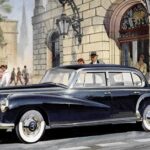
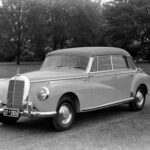
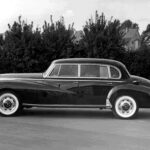
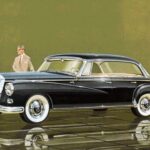
In August 1957 a profoundly revised version of the 300 model was presented, which, technically as well as regarding its exterior, was clearly different from its predecessor. The fact that this model was a new construction was confirmed by the construction description W 189, which showed that the 300 d model, as it was internally called, really belonged to an independent product line. And yet, the conceptual similarities to the 300 c model were obvious: the chassis and frame were derived from its predecessor, but only the longer version with the 3150 mm wheel base. The most significant technical change, however, related to the engine: carburation was no longer effected by a carburettor but by intermittent suction pipe injection. Together with an increase in compression this resulted in an increased engine power of 160 hp. The 300 d was serially equipped with the "Detroit-Gear" automatic gearbox: As an optional, however, the car was also available with a manual gearbox. From March 1958, the customers could order a ZF-Saginaw-power steering as special equipment, which remained a privilege of the customers who had opted for the automatic version, however. the 300 d model was the first Mercedes-Benz passenger car which could be fitted with another special equipment, the Behr airconditioning unit , which became available from December 1958. However, at 3.500,= DM extra cost this was not exactly a special sales offer, however.
The car body of the 300 d had obviously been modernised, in particular the roof and rear part of the car; because of the filigree design of the c-pillars it was possilbe to increase window size by 30 %. The 300 model now boasted a car body, which afforded full panoramic views unhampered by pillars, which made it possible to open the side windows completely. This is why it was also described as a hard-top saloon car. After redesigning of the rear part of the car boot volume was increased by 15 %, as compared to the 300 c.
Apart from the saloon car, which, like its predecessor could be fitted with with sliding sunroof and/or bulkhead, another convertible D was available from December 1958. An extra cost of 8.500 DM guaranteed high exclusivity and low scale manufacturing of this version.
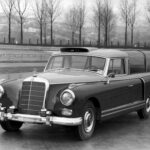
Four individual cars, which were built in 1960, on the basis of the 300 d model were even more exclusive. Three of them, one Pullman saloon car and two Pullman-landaulets were constructed on a longer chassis with a 3600 mm wheel base. They also had a much higher roof top. One of the two Landaulets was a special design for Pope John XXIII with one individual seat in the rear cabin and was handed over to him in December 1960. The second Landaulet and the Pullman-saloon remained the possession of Daimler Benz, which used them as representative cars to be hired out for special events to the federal government or to other wealthy customers.
The fourth car was not suitable for representative purposes and as such not intended for the public eye. It was a two-door station wagon with a completely new car body and for many years it came to good use as a powerful measuring car in the test department.