Tire inflation pressure
WIS 40-106
Note The tire inflation pressure specified by vehicle manufacturer is determined in accordance with the following criteria:
1. Consideration of axle loads on vehicle under influence of full load.
2. Consideration of attainable max. speed of respective vehicle.
3. Good driving characteristics, also for sports-style driving.
4. Satisfactory driving comfort.
5. Favorable tire wear pattern.
A wrong tire inflation pressure, particularly when the air pressure is too low, will influence the driving characteristics and the life of the tires depending on extent of deviation from specified value, and will also lead to an additional, higher fuel consumption.
If the tire inflation pressure is too low, flexing and thereby excessive heating will increase. The understructure of such a tire will lose its compactness. The results: tread and belt will come loose. Depending on size of reduced inflation pressure and driven speeds, the life of the tire will become shorter, while even short-term “inflation pressure sins’’ may lead to permanent damage.
On the other hand, a tire inflation pressure which is essentially too high (higher than the values named for fast driving or for max. loads) incorporates the disadvantages of a high loss in comfort, while the smaller tire road contact area results in a worsening of driving characteristics and on a wet road also in a higher trend toward aquaplaning.
Notes concerning tire inflation pressure checkup
1. Check inflation pressure of tubeless tires every two weeks.
On tube-type tires, checking inflation pressure once a week will be of advantage.
2. Measure inflation pressure as much as possible when tires are cold, while taking the respective outside temperature into account. Here, approx. 10 °C are equal to an air pressure change by 0.1 bar.
Example 1
The specified air pressure is valid if the temperature of the tires is in accordance with outside temperature.
Example 2
If the temperature of the tires is equal to room temperature (ambient temperature) e. g. + 20 °C, and the outside temperature amounts to approx. 0 °C, the tire inflation pressure must be set 0.2 bar higher than the specified air pressure.
3. If the inflation pressure is measured on warm tire, an increase up to 0.5 bar must be taken into consideration depending on extent of heating up caused for example by fast driving on a highway, by hot weather or by exposure to sunshine. Following normal driving, the increase in air pressure will amount to approx. 02. bar.
4. If an inflation pressure checkup on a single wheel will always show a higher drop in inflation pressure than on the other tires, the respective wheel should be checked.
The following causes may be responsible:
a) Penetration of foreign bodies.
b) Damaged tread or side wall.
c) Leaking valve bodies or valve elements (refer to item 4).
d) On tubeless tires leak between tire bead and rim.
e) On tube-type tires, leaking innter tube.
f) On tubeless tires leaking rim e. g. crack in welding seam or faulty welding on steel plate rims or porous spot on cast light alloy rims (products from other manufacturers).
5. If the valve cap is not screwed on again following a tire inflation pressure checkup, penetrating dirt may settle at edge of valve element during next inflation pressure checkup and will subsequently result in a creeping inflation pressure loss.
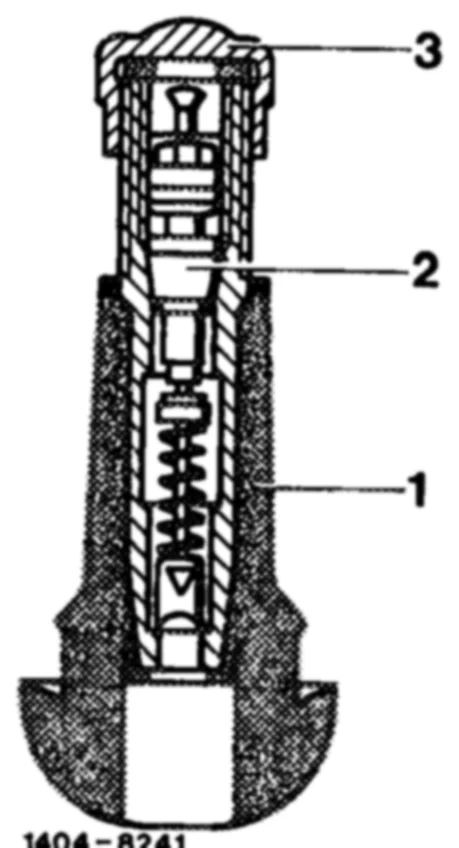
6. Use only metal valve caps or valve caps made of hard (rigid) plastic material with rubber sealing ring recommended by us. In contrast to caps made of soft plastic material, these caps guarantee additional sealing in the event of a leaking valve element.
1 Valve body 2 Valve element 3 Valve cap with rubber sealing ring
Models 107, 116, 126
Cold tires


Winter tires Model up to 190 km/h a Dri OY =e
107
Partial 116.02 load 116.032 237) 2.69) 116.033 Max. 116.120 load
Partial load 2.3 2.5 116.036 Max. load
126.02 Partial 126.032 load 126.033 126.0377) Max. 126.043 load 2.3 2.6 Partial 126.036 load 126.037°) 126.044 Max. load
Partial load 126.120 Max. load
Spare wheel Warm tires
All models
Max. inflation pressure of rear Higher inflation pressure readout up to + 0.5 bar, therefore do not discharge air wheel tires
To improve driving comfort for speeds up to 160 km/h, inflation pressure can be dropped by bar for summer tires. To improve driving comfort for speeds up to 180 km/h, inflation pressure can be dropped by bar for summer tires. Formerly 2.2/2.5 bar. Vehicles with hydropneumatic suspension. Vehicles with steel suspension.
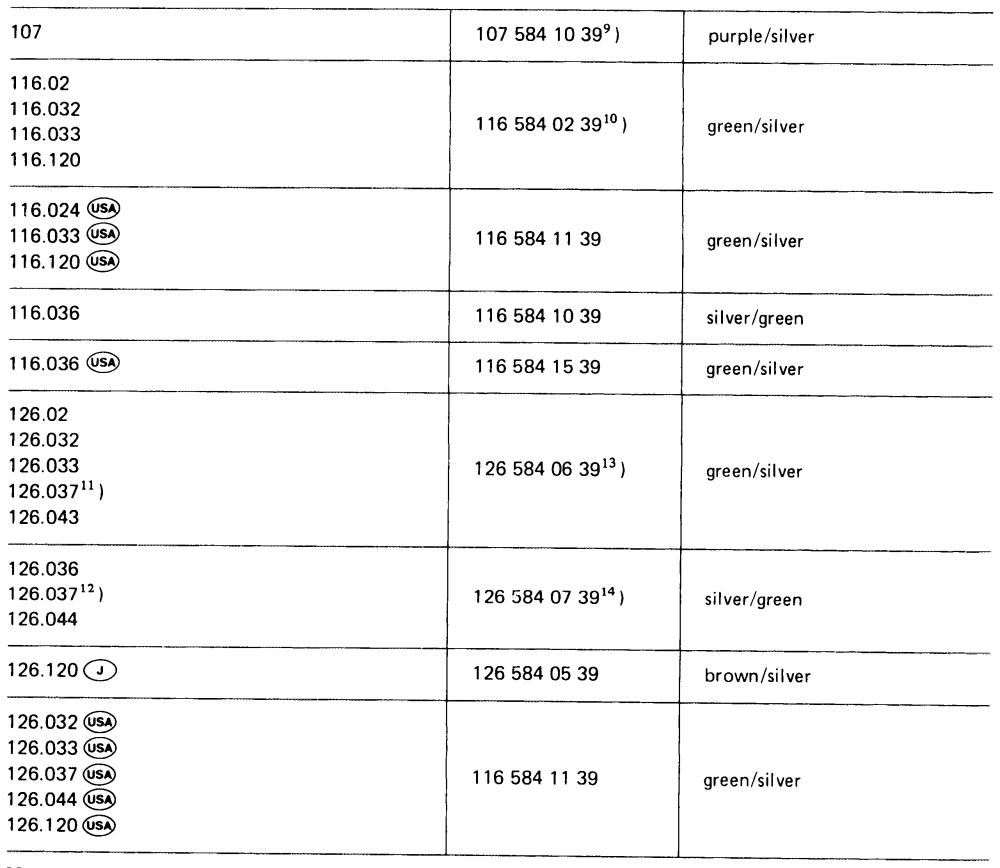
Model Part no. Color base/letters
Models 107, 116, 126
Model 201

pressure 39 applied to models 114.01, 114.02 and 115. Formerly 116 584 02 39. The max. permissible axle loads for the individual models are shown in vehicle documents or on type rating plate. Formerly 123 584 04 39. Tire inflation label attached up to January 1980. Tire inflation label attached starting February 1980. Also applies to vehicles for the purpose of cleaning the rails. Tire inflation label attached starting March 1978 (formerly 114 584 02 39). Formerly 107 584 08 39 or 107 584 00 39. With tires 205/70 R 1493 T M+S up to 190 km/h, valid tire inflation label 116 584 21 39. Vehicles with hydropneumatic suspension. Vehicles with steel suspension. Tire inflation label attached starting September 1981 (formerly 126 584 00 39). Tire inflation label attached starting September 1981 (formerly 126 584 01 39).