aide # G17 AS00.00-X-10002 1
WIS misc-mech1-specialtools

G17
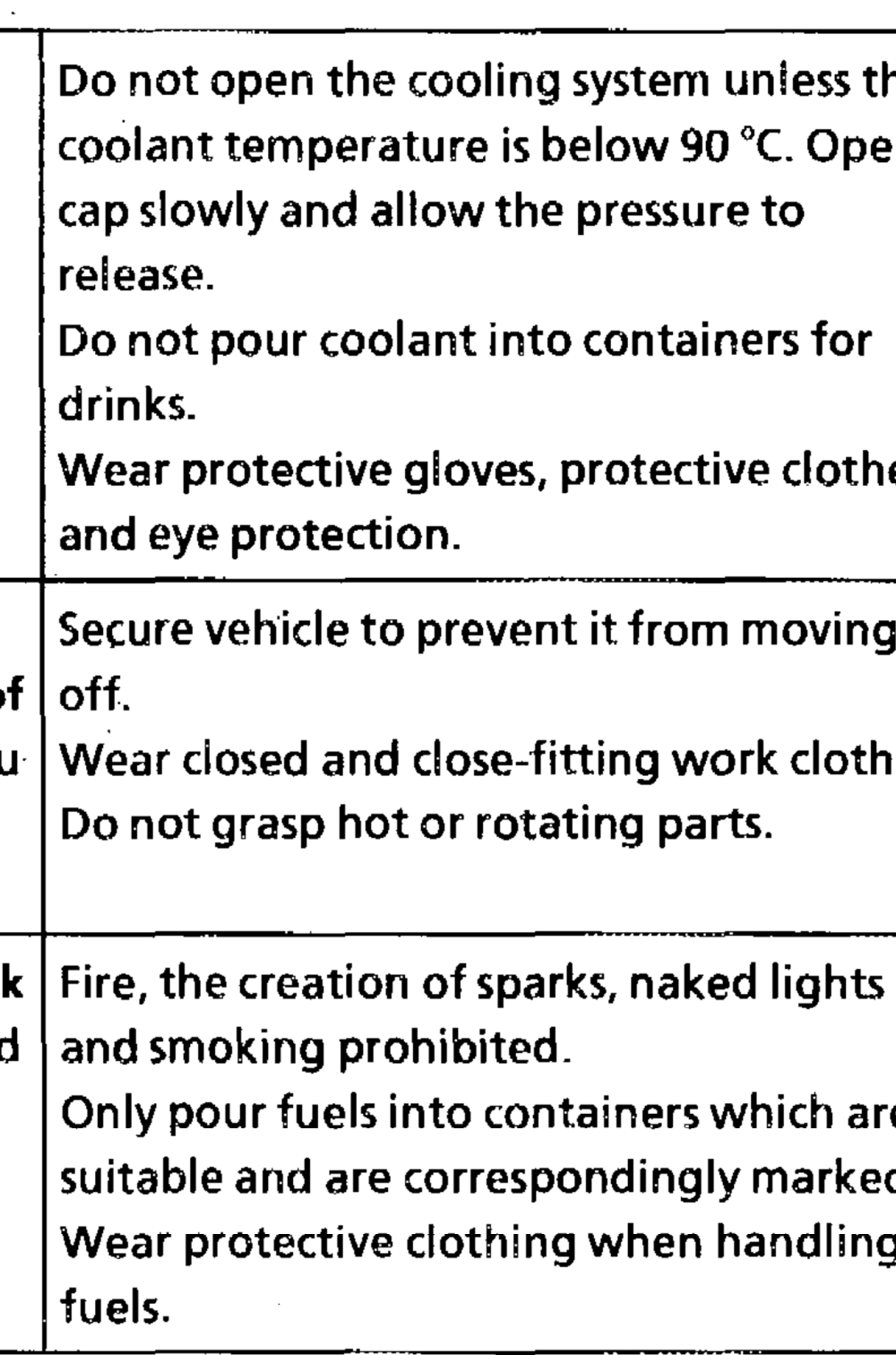
Risk of injury to skin and eyes from the scalding from hot coolant which splashes out..Risk of poisoning from swallowing coolant.
Risk of accident as a result of vehicle starting off when engine is running. Risk of injury as a result of bruises and burns if you: insert your hands into engine when it is being started or when it is running.
Risk of explosion from ignition of fuel, risk of poisoning if fuel is inhaled or swallowed and risk of injury if skin or eyes come into contact with fue!
Do not open the cooling system unless LN Danger! H17 AS20.00–2-0001-01A _—- Risk of injury to skin and eyes from scalding from hot coolant which splashes the coolant temperature is below 90 °C. Open cap slowly and allow the out..Risk of poisoning from swallowing coolant. pressure to release. Do not pour coolant into containers for drinks. Wear protective gloves, protective clothes, and eye protection.
Protective measures/rules of conduct
Possible dangers Allow cooling system to cool down to a coolant temperature
Risk of injury
of less than 90 °C. The cooling system is pressurized when the engine is warm. Risk Open coolant system cap slowly; open a conventional type of of scalding from hot coolant which splashes out if the cooling coolant system cap to the first detent and open a screw-type system is opened suddenly. coolant system cap about 1/2 turn, and allow the pressure to release. Wear protective gloves, protective clothes, and eye protection. Risk of poisoning If cooiant is swallowed, the person affected is likely to show signs Do not pour coolant into containers for drinks. of poisoning such as headaches, giddiness and stomach aches, paralysis of the respiratory system, unconsciousness, nausea, and
First aid measures
Pour large quantities of cold water over the affected area of convulsions. skin and cover over with sterile bandages. Have person affected drink plenty of water to which medicinal carbon has been added. Consult a doctor if the person affected has severe burns or has swallowed considerable quantities.
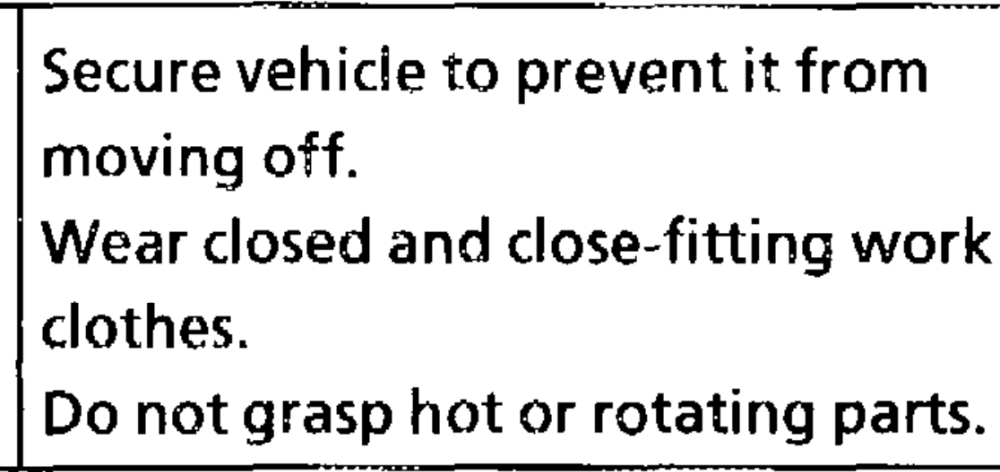
LN Danger! J17 AS00.00–2-0005-01A Risk of if you it is
Rules of conduct / Protective measures Possible dangers – Asageneral rule, carry out work on the running engine only if Risk of accident this is absolutely essential. from vehicle starting off during starting operation (e.g. when – Before starting the engine, apply parking brake. testing compression pressure) as a result of gear engaged or when
– Onmodels with manual transmission, move gearshift lever
engine running and vehicles with automatic transmission as a into Neutral position.
result of selector lever position “P” or „N” not engaged
– Onmodels with automatic transmission, move selector lever (exception: some vehicles do not have a selector lever position into position „P” or „N” (exception: some vehicles do not have a selector lever position „P“). „P”). – Onmodels which do not have selector lever position „P”, Risk of injury secure selector lever to prevent it from being operated Severe injuries may be caused by freely rotating parts in the area unintentionally. of the running engine. The heat produced by the engine when it – Wear closed and close-fitting work clothes. – Take off any jewelry, such as chains, rings etc. is Operating can result in severe burns if contact is made with individual, unshielded parts. – Ifyou have long hair, wear a suitable head cover. – Before commencing work on the running engine, check to obtain a general picture of the positioning of parts which may be hot. – When carrying out work when starting the engine or when engine is running, do not touch any hot and rotating parts.
First aid measures in the event of burns @ Donotrub the skin areas affected; flush with plenty of cold water and cover skin with sterile bandages. e Immediately consult a physician.
# G17 AS60.00-X10002 5
Fire, the creation of sparks, naked Ay Danger! Risk of explosion from ignition of fuel, risk AS47.00-Z-0001-01A of poisoning if fuel is inhaled or swallowed lights and smoking prohibited. and risk of injury if skin or eyes come into Only pour fuels into containers which contact with fuel are suitable and are correspondingly marked. Wear protective clothing when handling fuels.
Potential dangers
Risk of explosion, poisoning and injury
Fuels are highly flammable and are poisonous if swallowed. Fuel – Always put drained fuel into containers which are suitable and can cause damage to the skin. Contact with gasoline fuel, for can be properly closed off. example, removes the skin’s natural oils. Fuel vapors are explosive – Immediately remove any fuel which has been spilt. and invisible, and spread out along the floor. They are poisonous if inhaled and can cause unconsciousness in high concentrations.
Working on the vehicle using a naked flame
(e.g. when welding etc.). Protective measures/rules for handling fuels – Before carrying out such work, remove the relevant parts of – Observe local national safety regulations. the fuel system and seal off open fuel lines with plugs. – Fire, the creation of sparks, naked lights and smoking forbidden. First aid measures – Make sure that the work area is sufficiently well ventilated. @ Wash any fuel from skin using soap and water. – Never drain or add fuels over workshop pits. e Change out of clothing on which fuel has been spilt as soon as possible. e If fuel is splashed into the eyes, rinse out the eyes immediately with water; consult a doctor if appropriate.