Coolant circuit and engine cooling
WIS 20-005
Coolant circuit
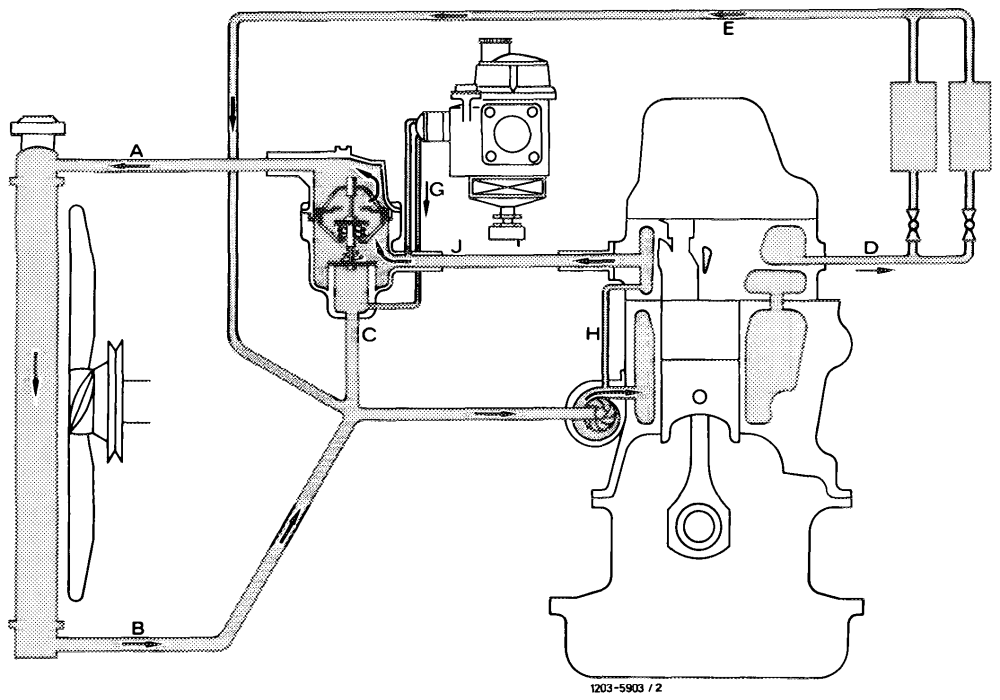
xromo Heating water, initial water From coolant thermostat housing to radiator QOwD> Heating water return flow From radiator to coolant pump Heating of starter cover on carburetor Bypass line (coolant thermostat housing Vent line (coolant pump to cylinder head) to coolant pump)
In order to obtain a better heating effect, instead of the coolant thermostat with 79 °C start of opening, a coolant thermostat with 87 °C start of opening, part No, 002 203 76 75, optionally 002 203 81 75, was installed. The former thermostat and the present one are exchangeable.
Start of series production: December 1975
Model Engine Engine end No. Chassis end No. manual transmission automatic transmission
115.923 217 101 041 721 299 630 115.015 115.926 017 833 000 751 115.017 115.951 047 921 027 009 074 286
115.938 000 036 000 013 000 035 123.020 115.939 000 001 000 001 123.023 115.954 000 026 000 019 000 041
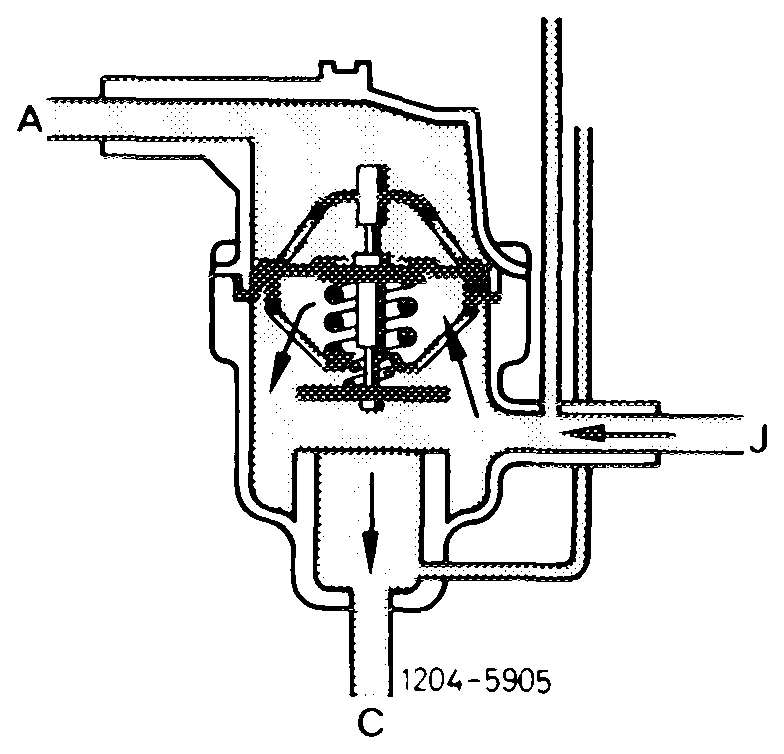
Warm-up stage (coolant temperature up to approx.
79 °C or up to approx. 87 °C)
The main valve is closed and the short-circuit valve fully opened. Coolant flow (A) to radiator thereby is interrupted and coolant flows via bypass line (C) directly to coolant pump, and from there to engine.
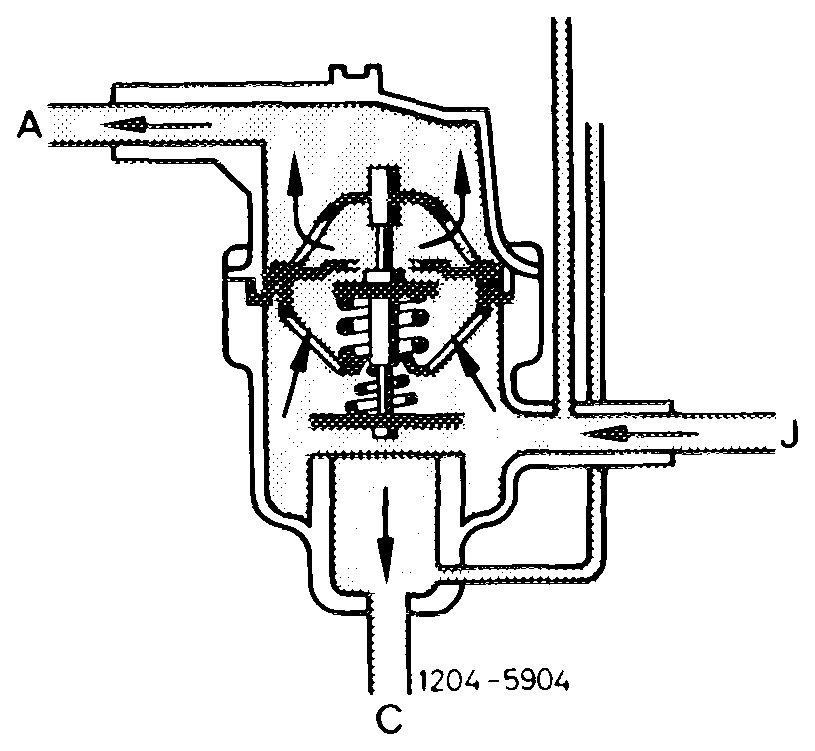
Partial-load operation (coolant temperature approx. 79 °C to max. 94 °C or 87 °C to max. 102 °C)
Main valve and bypass valve are opened more or less wide, depending on engine load and ambient temperature. Coolant is flowing, in dependence of thermostat position, both through radiator (A) and bypass line (C).
Full-load operation — High ambient temperatures
(coolant temperature above 94 °C or above 102 °C)
Main valve is fully opened and bypass valve closed. All the coolant should flow through radiator, which thereby is cooled in the best possible manner. It is therefore wrong to remove thermostat for better cooling engine.
Engine cooling
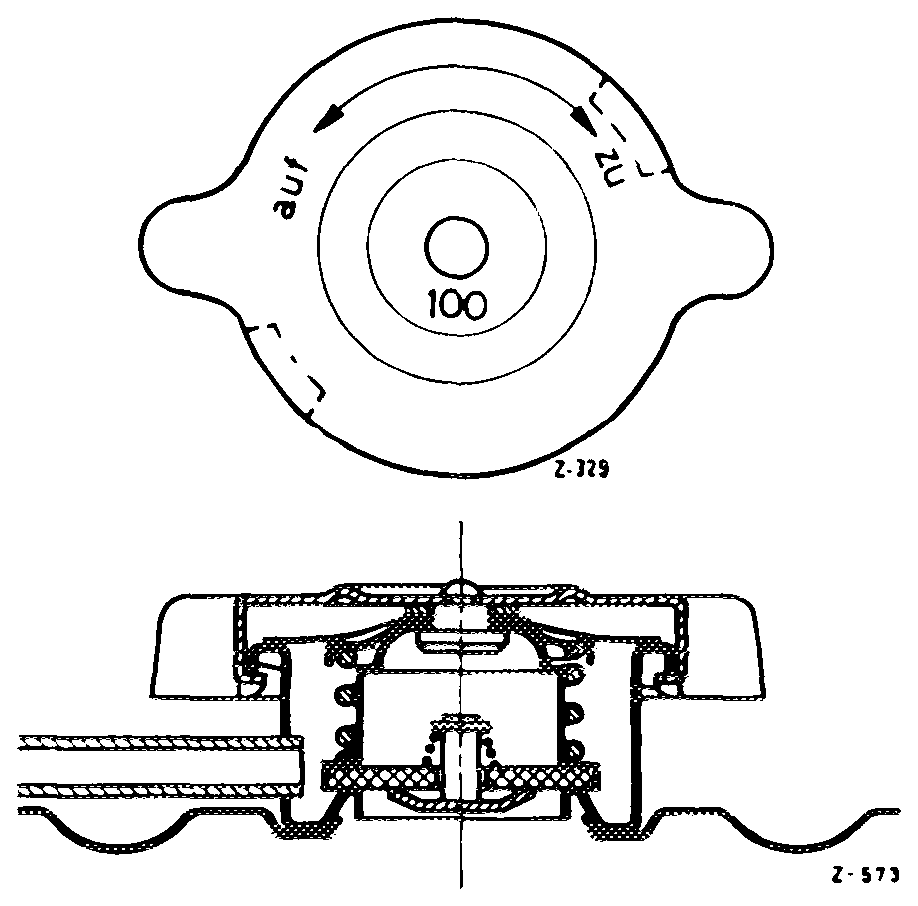
The spring-loaded radiator cap (code No. 100) serves to establish a gauge pressure of approx. 1 bar (atii) in cooling system.
The cooling system is filled ex factory throughout the year with a coolant which comprises approx. 55 % by volume water and 45 % by volume anti-freeze.
This will guarantee a protection against freezing up to -30 °C, while in addition corrosion in cooling system is prevented by additives in anti-freeze. Since the additives are subject to ageing, the coolant should be renewed every 2 years.
As a protection against corrosion, the concentration of the anti-freeze should not drop below 30 % by volume (—20 °C anti-freeze protection).
Attention! Approved anti-freeze agents may be used only, in order to prevent damage to light-metal components.
lf no anti-freeze is available and only water is filled in, make sure that 1 % of a treating agent (anti-corrosion oil 10 cc/I water) is added.
For lubrication of heating valves on model 115, always add 1 % = 10 cc/I of treating agent on principle, even when already using anti-freeze.
The anti-freeze will increase the boiling point, which for water and 1 bar gauge pressure is at approx. 118 °C, with the mixture filled-in ex factory to approx. 125 °C.
The red mark on the coolant temperature indicator starts at 122 °C (on model 115 up to May 1975 at 115 °C).
This point should be particularly observed if only water with treating agent is filled in. In this case, water may be thrown out before the coolant temperature indicator has achieved the red mark.
At full load, while driving uphill and bumper-tobumper, after fast driving on express ways with subsequent vehicle congestion, or while driving in areas with high ambient temperatures, the coolant temperature indicator may rise up to red mark, with an anti-freeze protection up to min. —30 °C, without any ejection of coolant or an irregular engine performance.
During extended stationary operation, e.g. in a traffic congestion, moving the selector lever into position “N“ will be of advantage for vehicles with automatic transmission. This will reduce the heat generated in the transmission and, consequently, the additional heating of coolant via transmission.
If coolant is lost through leaks in the cooling system or through ejection as a result of overheating, a pertinently treated coolant must be added. Losses caused by evaporation can be topped up with tap water.