701 Bleeding brake system
Revision: Specifications of service products revised. Model 100
Brake fluid
Use specified brake fluid only refer to , Specifications for Service Products’’ page 331.0
Note be paid to colorless brake fluid or brake fluid tinted yellow, since the risk of confusion is particularly During operation, the boiling point of the brake fluid high here. If mineral oil is found in brake system, or will drop as a result of the continuous absorption of if mineral oil is suspected, flush entire brake system, moisture from the atmosphere. During all-out braking, and replace main cylinder. the braking system may be subject to vapor lock. For this reason, be sure to renew brake fluid once a year, if possible in the spring. c) Do not permit brake fluid to touch paintwork of vehicle, since fluid contains particles which will Handle brake fluid carefully! dissolve paint. a) Fill brake fluid only into containers which make d) Brake fluid is highly hygroscopic, that is, fluid consumption by mistake impossible (fatal dose 100 cc). will absorb moisture from the air, which in turn will lower the boiling point. For this reason, store brake b) Already minor traces of mineral oil will result in fluid only in well-sealed containers. failure of the brake system. Particular attention must
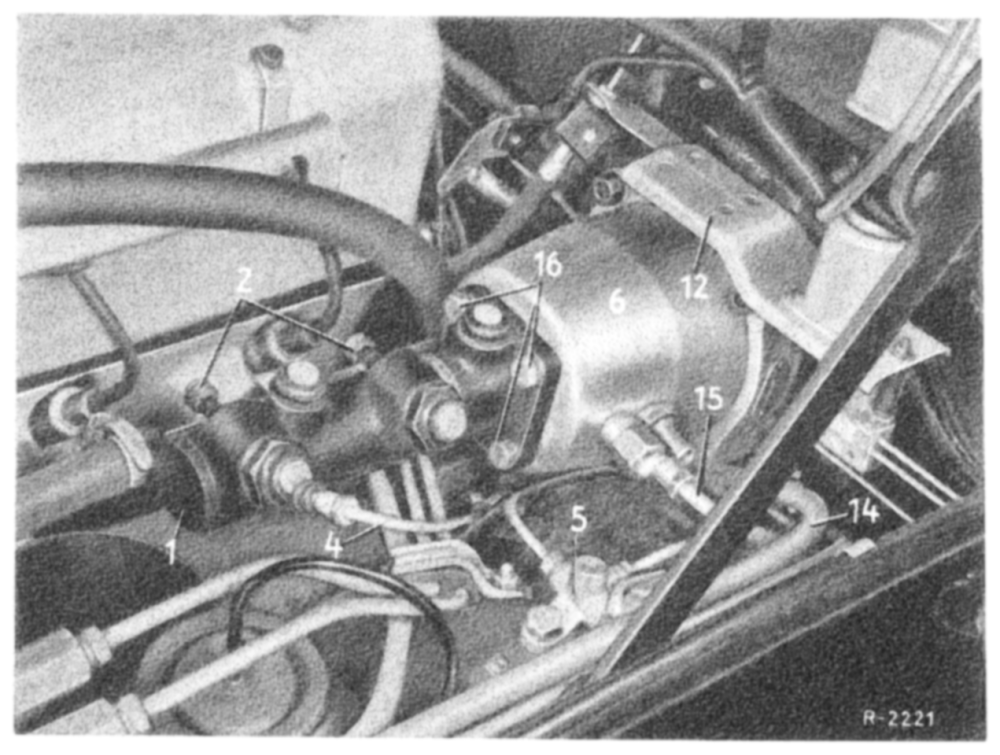
- Remove top from reservoir and fill with new brake fluid up to the marks stamped in the reservoir (also refer to job no. 700).
- First bleed master cylinder at both bleeder screws. To bleed brake system, loosen bleeder screws by J turn and slowly depress the brake pedal. Before allowing the brake pedal to rise, close the bleeder screw, so that no air is sucked in through the thread. Repeat the bleeding procedure until bubble-free brake fluid flows from both bleeder screws.
- Close bleeder screws with rubber caps.
- Replenish fluid level in reservoir. The brake fluid 2 Bleeder screw pumped out may not be reused. Unscrew top, making sure that the ventilation bore is not blocked (alro refer to job no. 700).
- Check travel of brake pedal. |t may be a max. of 75 mm to the triggering point of the brake booster (distinct, firm stop), and with compressed air assistance (the compressed air warning light must not be illuminated).
If the path of the brake pedal is longer than 75 mm, also bleed the 4 calipers at front axle and the 2 calipers at rear axle.