Types 300 S and 300 Sc (W 188)
Production: 1951 - 1958
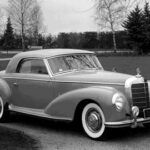
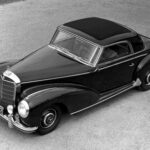
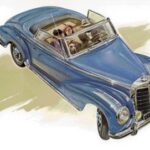
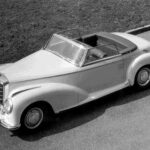
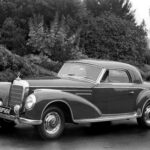
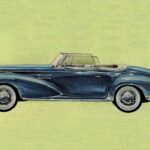
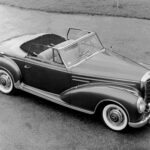
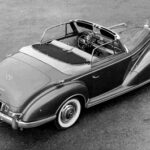
Types
| Type | Model | Production | Number produced |
|---|---|---|---|
| 300 S Cabriolet A | W 188 I | 09.51/06.52 - 07.55 | 203 |
| 300 S Coupé | W 188 I | 09.51/08.52 - 08.55 | 216 |
| 300 S Roadster | W 188 I | 09.52 - 06.55 | 141 |
| 300 Sc Cabriolet A | W 188 II | 01.56 - 07.57 | 49 |
| 300 Sc Coupé | W 188 II | 09.55/12.55 - 04.58 | 98 |
| 300 Sc Roadster | W 188 II | 01.56 - 02.58 | 53 |
History
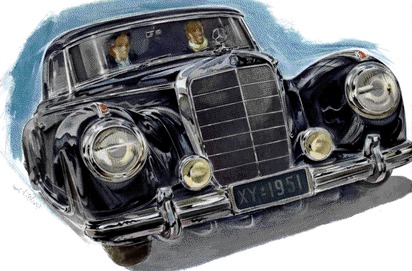
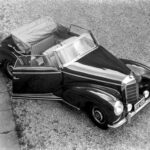
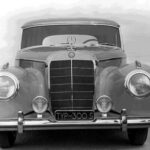
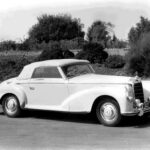
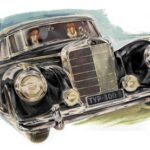
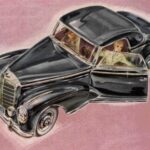
In October 1951 - on month before serial production of the 300 model was launched - another top model, the 300 S model, was presented at the Paris Motoring Show; this completed the now well rounded production range of Daimler Benz, which - as before the war - fulfilled the highest expectations. The new model was positioned as a parcticularly representative car with sports-car characteristics and it met the highes demands with regards to roadability and speed. That the 300 S model indeed justified this high ranking was demonstrated by the judgement of the international automobile press. The press hailed the new model as "car of the world elites" and as a "model for what can be achieved today in automobile construction" . The car also won praise for its "traditional and in this case particularly noble form [...] without taking recourse to aerodynamics".
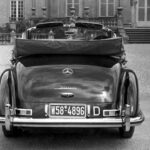
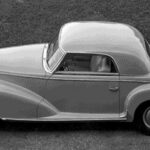
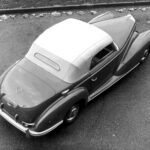
Technically the 300 S was derived mainly from the 300 model. In contrast to the 300 model, however, It had a curtailed chassis with a wheel base, which was 150 mm shorter. Higher Compression and the addition of three carburettors boosted engine power to 150 bhp. This made a maximum speed of 175 km/h possible. The 300 S model was available as convertible A, as Roadster and as a Coupe. The roadster basically corresponded to the convertible A, but it had a lighter, fully retractable hood without storm bars. Serial production of the three versions started between June and September 1952.
In September 1955 a revised version of the 300 S model was presented together with the 300 c at the International Automobile Fair in Frankfurt. The most significant changes had taken place in the rear axle and the engine. The revised model, internally called 300 Sc, had a single-joint cross shaft axle with a low pivot, like the 300 c. Carburation did no longer take place with the help of three carburettors but by direct injection; As a result of higher compression engine power was increased to 175 hp.
The car body, too, had changed: the 300 Sc had knockout windows at the sides and bigger indicators at the front and the rear. New distinguishing features were also two horizontal chrome lined bonnet louvers on both sides below the bonnets as well as chrome trims extending from the front to the rear wheel arches. A chrome sign ,injection engine", attached to the boot lid below the handle indicated that the car had a more powerful engine.
Inspite of technical and visual improvements only 200 cars were produced with the three body versions of the 300 Sc. From the beginning of 1957 public interest in the car had almost died down so that production of the 300 Sc was phased out in April 1958. Part of the reason for this development was probably the new 300 SL Roadster which many potential customers found more attractive - it combined modern design with an increased ride performance and it was, last but not least, 4.000,= DM cheaper.
Both versions, the 300 S as well as the 300 Sc, belong to the most exclusive Mercedes-Benz passenger car models of the postwar era and, together with the 300 SL, they are the most sought after models among car lovers.