"Ponton"-Coupés and -Convertibles, types 220 S and 220 SE (W 180, W 128)
Production: 1956 - 1960
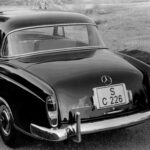
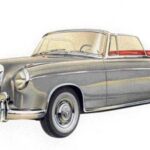
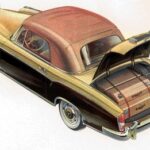
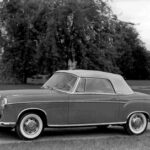
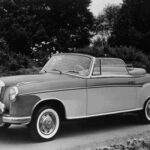
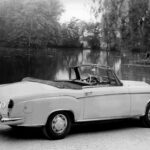
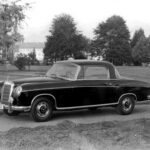
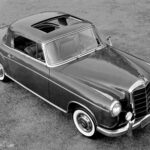
Types
| Type | Model | Production | Number produced |
|---|---|---|---|
| 220 S Coupé | W 180 II | 10.56 - 10.59 | 1.251 |
| 220 S Cabriolet | W 180 II | 07.56 - 10.59 | 2.178 |
| 220 SE Coupé | W 128 | 07.58/10.58 - 11.60 | 830 |
| 220 SE Cabriolet | W 128 | 07.58/10.58 - 11.60 | 1.112 |
History
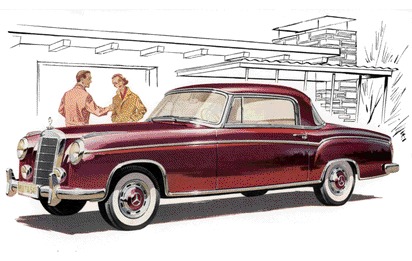
Two months after the last 220 convertible A had rolled off the conveyor belt in Sindelfingen a successor, the 220 convertible A/C, was presentet at the International Automobile Fair in Frankfurt. This elegantly shaped new model, had technically been based mainly on the saloon type 220 a, which had been produced for one-and-a-half years then. However, It was built onto a framework, which was 120 mm shorter. Deliveries of the aesthetically designed model were planned to start during the second quarter of 1956. However, this never happened, at least not according to plan - the open version - an open version of the 220 a was never serially produced.
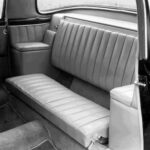
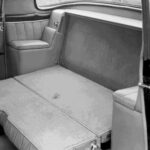
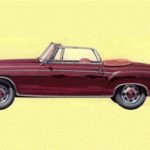
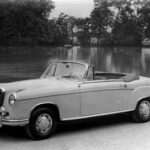
The convertible produced from July 1956, was based instead on the 220 S, the successor of the 220 a, which had been presented in March. The exterior of the new convertible-version was completely identical with the model, which had been presented at Frankfurt; A novelty, however, was the powerful 100 bhp engine, taken over from the 220 S saloon car. This unit gave the model, which had increased in weight by 60 kg because of the required body stiffness, adequate engine power. Three months after the convertible was launched, a coupe version appeared on the market, which was identcal with the open version except for its fixed roof.
In August 1957, improved versions of almost all types of the passenger car programme were presented, following the motto ,even more value at no extra cost";K The 220 S Coupe and convertible, too, had undergone model revision which led to slight modifications and an increased engine power of 106 bhp. Visible From outside were only the changed front fender with the number plate panel as well as the modified illumination of the rear number plate, which - as with the saloon cars - had been transferred to the fender attachments. Remarkable was the new hydraulic clutch automat "Hydrak", which also had been presented in August, as an optional for the coupe and the convertible.
At the same time as the saloon car, i.e. From September 1958, Ab September 1958, both versions were also offered as 220 SE with fuel injection. Except for the engine, the coupes and convertibles, internally code-named W 128, corresponded to their carburettor-fitted sister models 220 S. The 2,2 liter-6 cyl.-unit had a different carburation system, compared to the well-tried engine of the 220 S, however. As with the 300 d , Carburation was effected via intermittent suction pipe injection. A Power increase of up to 115 bhp was now possible. Improved driving performance and a more better fuel-consumption of the injection engine was only available at an extra cost of 1.900,= DM. For another 450,= DM the automatic clutch "Hydrak" was available as an optional.
In August 1959, three completely reconstructed six cylinder models with tailfin body were presented and in the same month production of the pontoon saloon cars 219, 220 S and 220 SE ended. The production of the Convertible and coupe continued only in the shape of the 220 SE model, however; The last carburettor versions rolled off the conveyor belt in October 1959. From August 1959 the modified injection engine of the 220 Seb type was used for both models, which due to a straight suction pipe and steeper camshaft now delivered 120 bhp.
In November 1960, production of the 220 SE Coupes and convertibles was stopped; As their successors, a new convertible was presented in February 1961 and a new coupe in August 1961. with only 5.731 models of these types having been built, 1.942 with injection engine, these "pontoon" coupes and convertibles belong to the rarer Daimler-Benz models after the war.