"Pagoda roof-SL", types 230 SL - 280 SL (W 113)
Production: 1963 - 1971
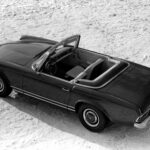

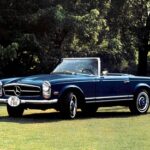
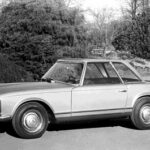
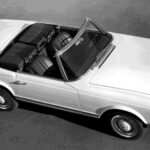
Types
| Type | Model | Production | Number produced |
|---|---|---|---|
| 230 SL | W 113 | 03.63/07.63 - 01.67 | 19.381 |
| 250 SL | W 113 A | 11.66/12.66 - 01.68 | 5.196 |
| 280 SL | W 113 E 28 | 11.67/01.68 - 03.71 | 23.885 |
History
The Geneva Motoring Show in March 1963 became the scene of a remarkable debut which was widely covered in the media: With the Type 230 SL Daimler-Benz presented a new sports car which was to replace two models of the former sales programme at once. The new model was faced with a major challenge - not only because its two predecessors, the 190 SL and the 300 SL, had been extremely popular from the start and the 300 SL had even become a legend during its lifetime. The real challenge was the fact that, despite many similarities within the family of models, both models represented two radically different design concepts and it turned out to be rather difficult to make out something like a common denominator.
In a sense, the new model represented something of a compromise: the 230 SL, internally code named W 113, was neither an irredeemably tough roadster, nor a gentle boulevard-sports car - rather, it was a comfortable two-seated travel car with an excellent driving performance and maximum driving safety.
Apart from its wheelbase - the magic measurement of 2400 mm had been taken over unchanged - the new SL had almost nothing in common with its two predecessors. Still, the W 113 was not simply a new construction as its technical concept was mainly based on that of the 220 SE; For example, the new model took its curtailed and reinforced framework from the tailfin saloon car including the front and rear axle suspension. the engine, too, had been developed from the 2,2 litre aggregate of the 220 SE; By boring open the engine to 2,3 litre, enhancing compression and use of a six piston injection pump, power was increased to 150 bhp.
Apart from the serial 4=speed-gearbox, for the first time an SL=model had become available with an optional 4=speed-automatic gearbox. A third version came in May 1966 with a 5=speed-gearbox, produced by the cog wheel manufacturer Friedrichshafen (ZF).
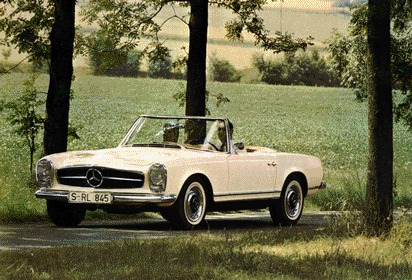
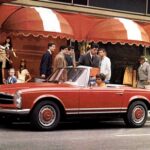
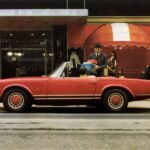
The 230 SL was the first sports car with a safety body with stiff passenger cabine and flexible front and rear; this had become possible by applying the construction principles of Béla Barényi, which had been used for the first time in the tail fin saloon cars. In contrast to these invisible construction elements, the body was characterised by one conspicuous design element: The 230 SL came with a removable hood, which had a concave shape, i.e. its surface curves inwards in the middle. This rather avantgardistic design was unusual for its time and met by no means only with approval. However, it was not an end in itself, but was a classical illustration for the designer maxim that ,form follows Function". According to the work of Béla Barényi, the pagoda shape lends a high degree of stiffness to the roof even if it uses a light construction; Moreover, access had become easier through the big side windows and vision had improved.
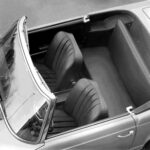
As with its predecessor, the 230 SL came in three versions: as a roadster with collapsible hood, as coupe with removable hood and as coupe with removable hood and a roadsterhood. All three versions could optionally be fitted with a transverse seat in the rear.
On 27. February 1967, the 250 SL, which was to replace the 230 SL after four years of production, was unveiled to the public. The newcomer, which was serially produced as early as December 1966, had the same exterior as its predecessor. Basic changes related to the engine and the brakes, which were derived from the 250 SE type in slightly modified form. The engine, the cubic capacity of which had been increased by 200 ccm after the stroke of the piston had been lengthened, achieved the same performance at 10 % higher torque and was moreover equipped with seven camshaft bearings and an oil cooler. Changes of the brakes comprised disk brakes at the rear wheels, bigger brake shoes at the front and the addition of an anti-wheel-lock-braking system. Incorporation of a bigger 82 instead of the 65 litre fuel tank increased the travel range of the car. Beside the tree 230 SL versions an optional fourth version was available for the 250 SL - a coupe with seats in the rear, which was presented for the first time in March 1967 at the Geneva Motoring Show. The additional space, which had become necessary for the incorporation of the rear seats had become available after the roadster hood and hood box were removed. Because it was impossible to backfit the hood, this version was to be recommended only in areas with little rainfall or after closing the coupe hood.
Less than half a year after its presentation, the 250 SL was replaced by a new model. When the new intermediate-class types were introduced to the markets, not only the saloon cars, coupes and convertibles of the top class, but also the SL was fitted with a 2,8 litre-engine. Owing to a camshaft with new control times, the engine version built into the 280 SL delivered an additional 10 bhp compared to the basic version of the 280 SE. Compared to the 250 SL, power had been enhanced by 20 bhp and torque by 10 %. Apart from the type label, the exterior of the 280 SL could be distinguished from its two predecessors only by its new decorative panels on the wheel arches.
In March 1971, production of the 280 SL was stopped. It was succeeded by a completely new design, the 350 SL type. In April 1971 its serial production began. Of the three SL-types of production line 113, a total of 48.912 units was produced in eight years. Alluding the the peculiarly shaped roof, the sports car models 230 SL, 250 SL and 280 SL are today referred to as "pagoda=SL".