Limousines of the series 124
Production: 1984 - 1995




















Types
| Type | Model | Production | Number produced |
|---|---|---|---|
| 200 D | W 124 D 20 | 05.84/01.85 - 08.89 | altogether 236.926 (until 08.95) |
| 200 D | W 124 D 20 | 09.89 - 07.93 | altogether 236.926 (05.84 - 08.95) |
| E 200 diesel | W 124 D 20 | 07.93 - 08.95 | altogether 236.926 (since 05.84) |
| 250 D | W 124 D 25 | 11.84/05.85 - 08.89 | altogether 236.811 saloons (until 07.93) |
| 250 D | W 124 D 25 | 09.89 - 07.93 | altogether 236.811 saloons (since 11.84) |
| E 250 diesel | W 124 D 25/2 | 12.92/07.93 - 06.96 | 41.411 saloons |
| 250 D turbo | W 124 D 25 A | 03.88/08.88 - 08.89 | altogether 48.876 (until 06.95) |
| 250 D turbo | W 124 D 25 A | 09.89 - 07.93 | altogether 48.876 (03.88 - 06.95) |
| E 250 turbodiesel | W 124 D 25 A | 07.93 - 06.95 | altogether 48.876 (since 03.88) |
| 300 D | W 124 D 30 | 03.84/01.85 - 08.89 | altogether 131.647 (until 07.93) |
| 300 D | W 124 D 30 | 09.89 - 07.93 | altogether 131.647 (since 03.84) |
| E 300 diesel | W 124 D 30/2 | 12.92/07.93 - 08.95 | 23.166 |
| 300 D 4MATIC | W 124 D 30 | 12.85/03.87 - 08.89 | altogether 1.485 (until 06.91) |
| 300 D 4MATIC | W 124 D 30 | 09.89 - 06.91 | altogether 1.485 (since 12.85) |
| 300 D turbo | W 124 D 30 A | 05.85/04.86 - 08.89 | altogether 38.908 (until 06.95) |
| 300 D turbo | W 124 D 30 A | 09.89 - 07.93 | altogether 38.908 (05.85 - 06.95) |
| E 300 turbodiesel | W 124 D 30 A | 07.93 - 06.95 | altogether 38.908 (since 05.85) |
| 300 D turbo 4MATIC | W 124 D 30 A | 10.87/03.88 - 08.89 | altogether 2.136 (until 03.95) |
| 300 D turbo 4MATIC | W 124 D 30 A | 09.89 - 07.93 | altogether 2.136 (10.87 - 03.95) |
| E 300 turbodiesel 4MATIC | W 124 D 30 A | 07.93 - 03.95 | altogether 2.136 (since 10.87) |
| 200 | W 124 V 20 | 03.84/01.85 - 08.89 | altogether 110.354 (until 06.90) |
| 200 | W 124 V 20 | 09.89 - 06.90 | altogether 110.354 (since 03.84) |
| 200 E | W 124 E 20 | 01.85/07.85 - 08.89 | altogether 176.660 (until 10.92) |
| 200 E | W 124 E 20 | 09.89 - 10.92 | altogether 176.660 (since 07.85) |
| 200 E | W 124 E 20/2 | 07.92/09.92 - 07.93 | altogether 82.588 (until 08.95) |
| E 200 | W 124 E 20/2 | 07.93 - 08.95 | altogether 82.588 (since 07.92) |
| 230 E | W 124 E 23 | 03.84/01.85 - 08.89 | altogether 374.422 saloons (until 10.92) |
| 230 E | W 124 E 23 | 09.89 - 10.92 | altogether 374.422 saloons (since 03.84) |
| 220 E | W 124 E 22 | 05.92/09.92 - 07.93 | altogether 105.346 (until 06.96) |
| E 220 | W 124 E 22 | 07.93 - 06.96 | altogether 105.346 (since 05.92) |
| 260 E | W 124 E 26 | 08.84/09.85 - 08.89 | altogether 154.391 (until 10.92) |
| 260 E | W 124 E 26 | 09.89 - 10.92 | altogether 154.391 (since 08.84) |
| 260 E 4MATIC | W 124 E 26 | 09.89 - 06.91 | altogether 1.943 (since 10.86) |
| 260 E 4MATIC | W 124 E 26 | 10.86/04.87 - 08.89 | altogether 1.943 (until 06.91) |
| 280 E | W 124 E 28 | 06.92/09.92 - 07.93 | altogether 57.302 (until 08.95) |
| E 280 | W 124 E 28 | 07.93 - 08.95 | altogether 57.302 (since 06.92) |
| 300 E | W 124 E 30 | 04.84/04.85 - 08.89 | altogether 258.063 (until 11.92) |
| 300 E | W 124 E 30 | 09.89 - 11.92 | altogether 258.063 (since 04.84) |
| 300 E 4MATIC | W 124 E 30 | 12.85/04.87 - 08.89 | altogether 14.202 (until 04.95) |
| 300 E 4MATIC | W 124 E 30 | 09.89 - 07.93 | altogether 14.202 (12.85 - 04.95) |
| E 300 4MATIC | W 124 E 30 | 07.93 - 04.95 | altogether 14.202 (since 12.85) |
| 300 E-24 | W 124 E 30/2 | 03.88/08.89 - 10.92 | 19.300 |
| 320 E | W 124 E 32 | 06.92/09.92 - 07.93 | altogether 63.950 (until 08.95) |
| E 320 | W 124 E 32 | 07.93 - 08.95 | altogether 63.950 (since 06.92) |
| 400 E | W 124 E 42 | 05.91/09.91 - 07.93 | altogether 22.802 (until 06.95) |
| E 420 | W 124 E 42 | 07.93 - 06.95 | altogether 22.802 (since 05.91) |
| 500 E | W 124 E 50 | 09.90/02.91 - 07.93 | altogether 10.479 (until 04.95) |
| E 500 | W 124 E 50 | 07.93 - 04.95 | altogether 10.479 (since 09.90) |
| E 60 AMG | W 124 E 60 | 09.93 - 11.94 | not documented separately |
| 250 D long | V 124 D 25 | 10.89/05.90 - 07.93 | 776 |
| E 250 diesel long | V 124 D 25/2 | 02.93/08.93 - 07.94 | 181 |
| 260 E long | V 124 E 26 | 09.89/05.90 - 09.92 | 1.006 |
| 280 E long | V 124 E 28 | 09.92/11.92 - 07.93 | altogether 379 (until 07.94) |
| E 280 long | V 124 E 28 | 07.93 - 07.94 | altogether 379 (since 09.92) |
| 250 D chassis for special-purpose bodies | F 124 D 25 | 04.86 - 08.89 | altogether 741 (until 06.93) |
| 250 D chassis for special-purpose bodies | F 124 D 25 | 09.89 - 06.93 | altogether 741 (since 04.86) |
| E 250 diesel chassis for special-purpose bodies | F 124 D 25/2 | 07.93 - 12.95 | 301 |
| 230 E chassis for special-purpose bodies | F 124 E 23 | 02.86 - 08.89 | altogether 224 (until 07.92) |
| 230 E chassis for special-purpose bodies | F 124 E 23 | 09.89 - 07.92 | altogether 224 (since 02.86) |
| 250 D chassis with elongated wheelbase | VF 124 D 25 | 07.85 - 08.89 | altogether 2.331 (until 07.93) |
| 250 D chassis with elongated wheelbase | VF 124 D 25 | 09.89 - 07.93 | altogether 2.331 (since 07.85) |
| E 250 diesel chassis with elongated wheelbase | VF 124 D 25/2 | 06.93 - 10.95 | 642 |
| 230 E chassis with elongated wheelbase | VF 124 E 23 | 02.86 - 08.89 | altogether 711 (until 10.92) |
| 230 E chassis with elongated wheelbase | VF 124 E 23 | 09.89 - 10.92 | altogether 711 (since 02.86) |
| 260 E chassis with elongated wheelbase | VF 124 E 26 | 08.86 - 08.89 | altogether 1.049 (until 10.92) |
| 260 E chassis with elongated wheelbase | VF 124 E 26 | 09.89 - 10.92 | altogether 1.049 (since 08.86) |
| 280 E chassis with elongated wheelbase | VF 124 E 28 | 09.92 - 07.93 | altogether 399 (until 09.95) |
| E 280 chassis with elongated wheelbase | VF 124 E 28 | 07.93 - 09.95 | altogether 399 (since 09.92) |
History
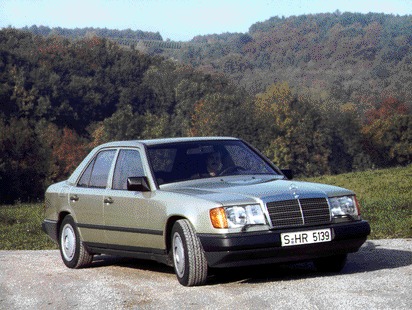
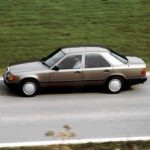
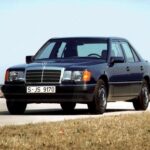
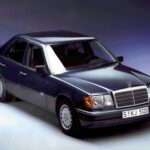
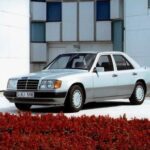
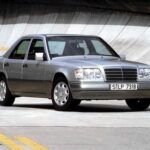
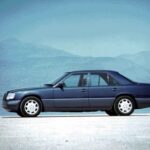
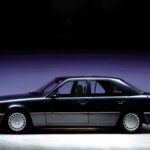
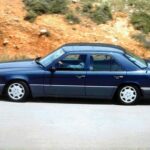
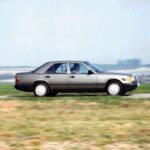
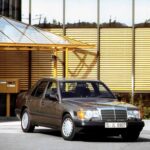
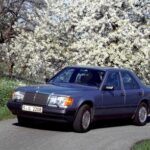
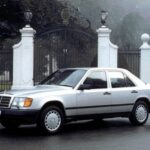
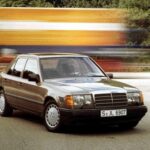
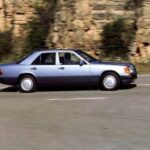
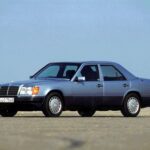
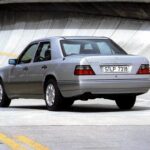
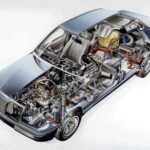
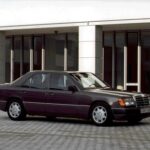
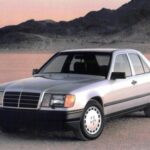
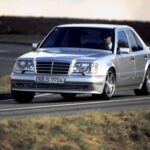
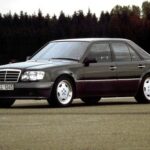
At the turn of the year 1984/85 a new model generation appeared in the medium-size series. It became the successor of series 123, produced for nine years. The technological overall concept of series 124 showed close parallels to the compact-class. By using high-strength steel sheets as well as other weight reducing materials and by an aerodynamic optimisation of the body, a considerable reduction of the fuel consumption had been achieved even in the medium-size series.
At the same time the safety standard, reached with the S-class and the comapct class in spite of the light construction, was further optimised. The passenger cabin of series 124 excelled by high side-impact and overturning resistance. It was equipped with ingenious deformation zones in nose and tail. The criterion in the asymmetric frontal impact with 40 % overlapping and at 55 km/h was now also fulfilled by the limousines of the medium range. Furthermore, for the protection of pedestrians and drivers of two wheel vehicles, the area of a possible contact zone was concipated as resilient as possible.
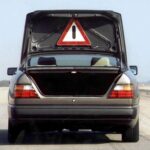
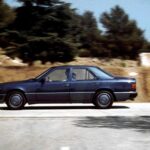
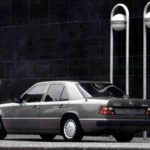
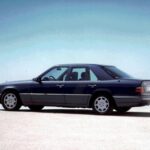
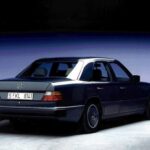
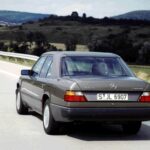
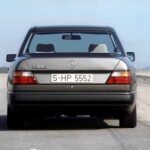
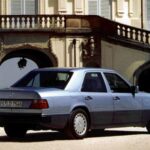
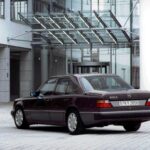
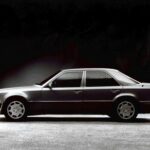
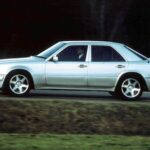
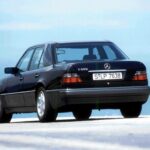
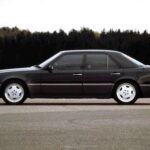
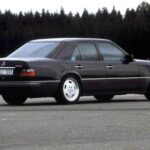
As to the stylistic design there were also many common features with the compact class. In spite of this, however, the new range of types also presenteditself with independent design elements. They were used forthe first time and had a factual-functinal background true to the principle ,form follows function". The characteristic shape of the tail tapering to the end and considerably rounded at the lateral top edges was aerodynamically especially favouraly. It was based on experiments in the wind tunnel. Two further typical design charactristics were the trapezoidal deeply pulled down boot-lid and the inclined inner edges of the almost square rear lights. They allowed a specially low loading sill which facilitated the loading of the voluminous boot.
A remarkable innovative construction detail were the lift controlled panorama wipers. With a 86% wiped windscreen view it was, at that time, the largest wipe pattern in the world. Thanks to a rotational movement overlapping the vertical movement the upper edges of the windscreen could be wiped much more efficiently than with the conventional one arm wiper. Electrically heated windscreen jets were part of the standard equipment of all models of this series.
The front and rear axle constructions, already known from the compact class, allowed an excellent driving performance. The new medium size models were also equipped with a damper strut front axle with individual A-arm suspension and anti-dive device as well as a multilink rear supension, in which each rear wheel was led by fife independent control arms.
The engines were mostly new developments. Only the four-cylinder aggregates came from types 200 and 230 E of the previous series W 123. Besides the completely newly constructed six-cylinder injection engines with 2,6 ltr. and 3,0 ltr. piston displacement, there was a new diesel engine generation. Its 2,0 ltr.-4 cyl.-engine had already been used in the 190 D and was now completed by a 2,5 ltr.-5 cyl.- as well as a 3,0 ltr.-6 cyl.-variant.
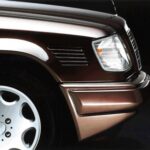
From the outside all models of the series were almost completely identical. The only difference were the twin-scroll rear silencers in the six-cylinder types and the front aprons with lamella like air inlet slots in the 300 D.
At the Frankfurt motor show IAA, in September 1985, eight months after the market introduction of the limousines, a T-model variant of series 124 made its debut. At the same time, the ,Mercedes-Benz driving dynamics concept" was presented. With ist automatic limited-slip differential (LSD), its acceleration slip regulation (ASR), and its automatic disengageable four-wheel drive 4MATIC it comprised three staged electronic-automatic driving dynamics systems.
The 4MATIC, the technically most expensive system of the new concept, was available for the six-cylinder limousines and the T-model of series 124. Besides the complex regulation electronics it comprised a complete additional front-wheel drive with transfer gear and differential. The conditions in the engine department of the 4MATIC-models made it necessary to integrate the compensating gear of the front drive train into the oil pan. These highly technical measures of this perfectionated front wheel drive system, however, had its consequences in the price. Types 260 E 4MATIC and 300 E 4MATIC, which were delivered starting spring 1987, were almost 12,000,- DM more expensive than their rear wheel drive counterparts.
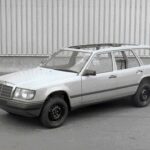
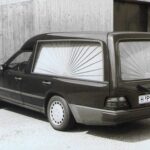
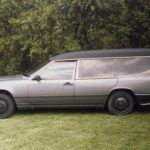
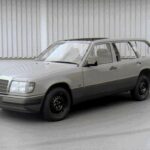
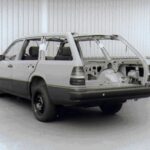
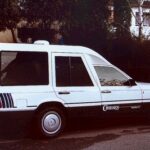
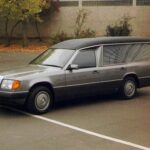
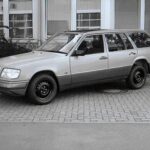
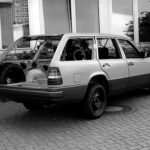
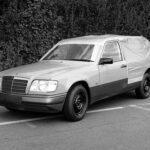
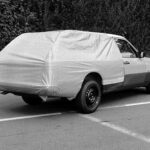
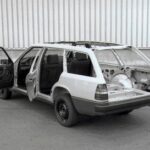
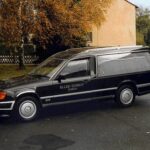
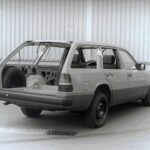
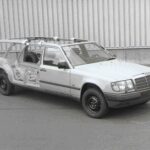
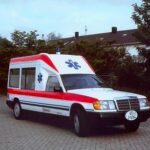
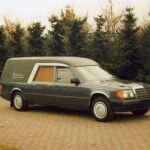
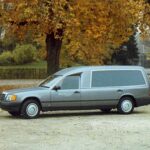
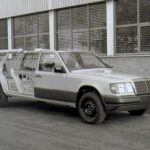
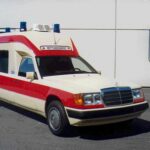
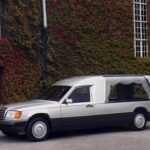
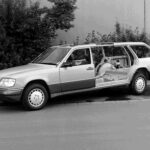
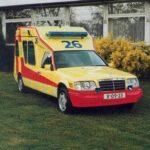
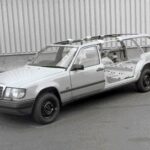
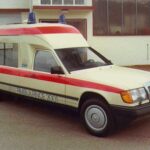
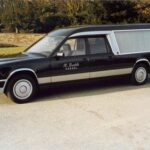
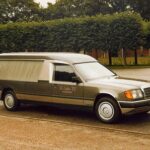
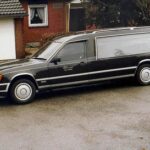
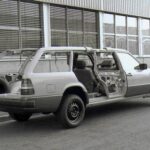
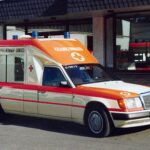
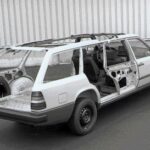
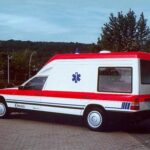
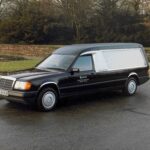
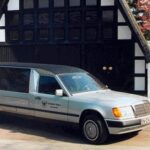
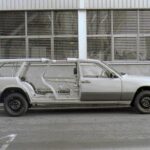
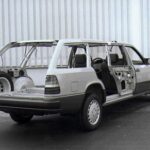
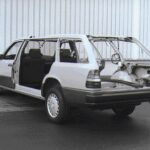
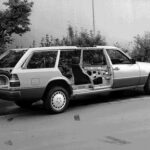
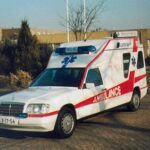
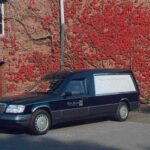
As it was usually the case for years with the medium-size series of Mercedes-Benz, the bodies of type range 124 were also available as partial bodies. They were used by body makers in Germany and abroad for ambulances, station wagons and other special versions. For the first time, the chassis was based on the T-limousines and together with them they were produced in Bremen. Besides the variant with normal wheel base, like types 250 D and 230 E, there was an additional longer version available as 250 D, 230 E und 260 E. Ambulance bodies on these chassis were mostly produced by Binz in Lorch, Miesen in Bonn and Visser in Leeuwarden. Among the most known producers of funeral cars on the basis of W 124 were the body makers Pollman in Bremen, Rappold in Wülfrath, Stolle in Hannover and Welsch in Mayen.
From September 1985 all petrol powered models of the series, with the exception of the carburettor type 200, were available on demand with a regulated emission control system with a lambda-probe equipped catalyst. An other special alternative was the so-called ,RÜF-version; here the vehicle was delivered without catalyst and lambda probe but with a multifunctional mixture-preparation and ignition system. Retrofitting a ,backfitting vehicle" with regulated catalyst was always possible and without problems. This handling allowed the client the highest possible flexibility as to the time of refitting. Since, at that time, unleaded petrol was not yet available everywhere, this was a considerable advantage.
The standard version of the six cylinder model was the RÜF-equipment. Due to the change to the MF-system its power had been slightly reduced. With the 230 E, however, for the time being, a RÜF-version was only available as a special equipment. From September 1986, the carburettor model was also available with an emission control system. Since that time the regulated catalyst has been part of the standard equipment of all Mercedes Benz passenger car models with Otto-engine. Back fitting models continued to be available on demand till August 1989 with a respective price deduction .
In the year 1987 the type program of series 124 was extended once more. First, at the Geneva car salon, in March, two coupe-models made their debut. They represented a third body variant. At the motor show IAA in Frankfurt, in September, two new limousines followed - types 300 D turbo and 300 D turbo 4MATIC. Both were provided with the 3,0 ltr.-6 cyl.- turbodiesel- aggregate, 143 PS strong. It had already been presented two years ago in the respective T-models. Only the 4MATIC-version was a world sensation. The conventionally powered 300 D turbo was part of the selling program of the American sales company MBNA beginning in 1986. The turbodiesel differed from the other models of the series also on the outside. Besides the air inlet slots in the front apron, also found in the suction-variant, there were fife additional air inlet gills at the right front wing.
At the Paris car salon, one year later, in September 1988, two further model variants of the medium-size series were presented -
types 200 E and 250 D turbo. Here, too, only one real newcomer was seen. The 200 E with the time-tested 2,0 ltr.=injection engine of the 190 E had already been produced for the Italian market for years. The 250 D turbo had come into existence by going back to the unit assembly system. In principle it corresponded to the 250 D. It was,however, provided with a supercharged 2,5 ltr.-diesel engine, which had already been used in the compact class. Now it was built into both types in a modified version.
In September 1988 changes took place. At the same time they were also carried out in the 3,0 ltr.- 6 cyl.- turbodiesel. The goal was a reduction of the particulate mass emission by improving the combustion process. It was reached by using a newly constructed prechamber with angular injection which guaranteed a more efficient combustion. A pleasant side effect of the new diesel technology was an increase in power of 4 PS in both models. Outwardly, with its additional air inlet slots, the 250 D turbo corresponded to its sister model with the 3,0 ltr.=turbo engine.
In September 1988, all models of the series received an extended standard equipment. Among it was the anti-locking system ALS and the heated right outside mirror. The washer system, which had been taken over from the S-class, was now provided with a heated washer tank as well as with heated jets and tubes.
Within the initiative ,Diesel '89" in February 1989, also the non-supercharged diesel passenger cars were provided with redesigned engines. They now also used the new prechambers with angular injection. In addition, the injection pumps of all diesel suction engines were equipped with an altitude pressure compensator in order to keep down emissions in altitudes as well. Thus the improved diesel models, whose particulate mass emission was reduced by 40%, fulfilled the strict USA particulate matter limit values even without a particulate filter. They worked practically smokefree. In the suction engines, too, the new diesel technology brought about a pleasant side effect. The optimising measures increased the power of the 200 D by 3 PS and of the 250 D and the 300 D by 4 PS.
With the help of an expensive exhaust emission control system the pollutant emission was further reduced. An oxidation catalyst, especially developed for the diesel engine, was combined with a carefully adjusted exhaust gas recirculation. From October 1990 this very efficient system was available for diesel passenger cars with suction engine, six months later also for the types with turbo engine on special demand.
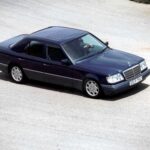
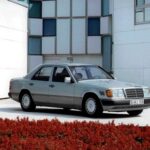
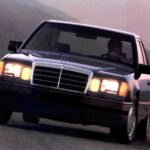
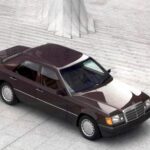
At the motor show in Frankfurt IAA , in September 1989, a completely redesigned model program of the medium-size class was presented. Most important were the stylistic novelties of the body and the newly equipped interior. The most eye-catching characteristic of the improved types were the lateral protection strips with integrated longitudinal sill trim which had already been introduced in an analogue form in the coupe-models two years ago. At their upper edge there were now additional small decorative fittings of polished stainless steel which continued on the upper side of front and rear apron. After a long time of abstinence they brought back in discreet form the often missed chrome shining.
This effect was reinforced by chrome decorative fittings at the door handles as well as by changed ornamental wheel caps, in which the Mercedes star and a small decorative ring at the circumference were also chrome-plated. A further novelty were the outside mirror bodies painted in the body colour. The interior, too, was newly equipped and revaluated by numerous details. Front and back seats were improved.
Starting from September, the ,sports-line" package was available on special demand for all types of series 124 - except for the 4MATIC-variant. It was already know from the compact-class models. An outward characteristic was the sports suspension which was provided with wide base tyres - dimension 205/60 R 15 - on all-aluminium or steel rim 7 J x 15. The body was allocated considerably lower. Furthermore, springs and bumpers were more closely adjusted. The interior was improved by leather steering wheel and leather shifter. There were individual front and back seats.
Besides the above-mentioned improvements in design and equipment, the redesigned type program of series 124 also presented fife completely new models. Limousine,coupe and T-models were now offered with a 3,0 ltr.-6 cyl.-four-valve engine - with 220 PS. It was based on the time-tested two valve engine which had already been presented six months ago with the 300 SL=24. Due to deviating installation conditions in types 300 E=24, 300 CE=24 and 300 TE=24 the catalyst cross section of the SL could not be used. Thus the nominal capacity was reduced by 11 PS.
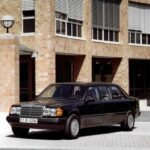
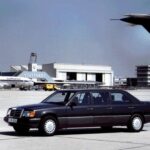
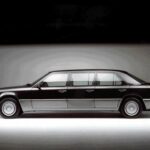
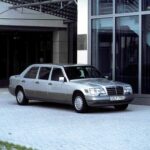
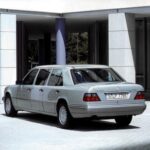
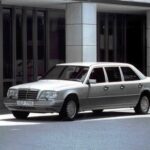
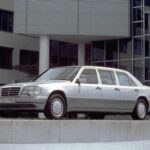
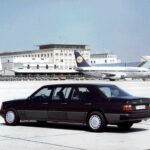
Besides the new top models of the series, a fourth body variant of the medium-size class was presented in Frankfurt - a limousine with prolonged wheel base. Thus, after a break of four years, there was again a long version in the selling program. The long body had been developed in close co-operation with the Binz company in Lorch. It also carried out the series production of the body shell. The wheel base had bee prolonged by 800 mm to 3600 mm. The overall length had been increased accordingly. In contrast to their predecessor models, types 250 D long and 260 E long presented themselves with six doors and a fully developed seat bench in the middle. As to its seat depth and backrest, it was almost similar to the rear seats. The series production of the long limousines was taken up in May 1990.
At the Paris salon in October 1990 a new top model of series 124 wa presented - the 500 E. From the outside a difference to the sister models could only be registered at second sight. The newcomer was provided with a 326 Ps strong 5,0 ltr.-V8-engine, based on the time-tested engine-gearbox unit of the 500 SL. It allowed breath-taking driving performance. With the standard four speed automatic gearbox 100 km/h were reached in 5,9 s, from a standing postion. The maximum speed was deactivated at 250 km/h. The standard equipment with traction control system (TCS) prevented the spinning of the driving wheels at full power. In order to reduce pollutants the volume of the twin scroll catalyst was increased from 3,9 ltr. to 5,8 ltr. Secondary-air injection and exhaust gas recirculation reinforced these measures.
In the 500 E a new variant of the V8-valve engine was used for the first time. It differed from the known equipment of the SL not only by a modified injection system, but also by a changed crank case. In stead of the mechanically-electronically controlled Bosch KE=Jetronic, for the first time the electronically controlled Bosch LH-Jetronic with air-mass sensor was used. The changes at the engine block were more thorough. It now displayed the same deck height as the little brother with 4,2 ltr. displacement. The installed height of the new uniform deck engine was reduced by 16.5 mm. Furthermore, it was cheaper in production. Bore and stroke remained unchanged. According to the low crank case, the shanks of the connecting rods were shortened
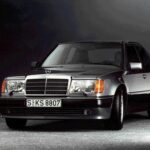
The characteristics of the 500 E were the discreetly broadened wings, the fog lamps integrated into the front apron as well as 16 inch all-aluminium wheels in 8-hole design with wide base tyres of dimension 225/55 ZR 16. The body was allocated 23 mm lower than in the other types. In order to compensate the compression travel needed for the payload, the standard rear axle had been equipped with a hydropneumatic level adjustment. The production of the 135,000,- DM expensive exclusive model was carried out in close co-operation with Porsche. The building of the body shell and the final assembly took place at Porsche in Zuffenhausen. The Mercedes plant in Sindelfingen was responsible for painting and delivery.
At the Frankfurt IAA, in September 1991, a further body variant of the medium-size class was presented - the 300 CE=24 cabriolet. After a break of exactly 20 years a four-seater cabriolet was again availabe .
One year later, in September 1992, a redesigned type program of the medium-size class was presented after the 2,000,000th vehicle of series 124 had left the assembly line. At the first improvement in autumn 1989 stylistic changes were important. Now it were engine and equipment. The petrol car presented itself with a thoroughly redesigned range of engines, which had been totally changed to four-valve technology. Two four-cylinder aggregates with 2,0 and 2,2 ltr.displacement, belonging to the newly developed engine series M 111, now replaced the time-tested two-valve engines from the type family M 102. The new engines excelled with increased power and a higher torque for the whole range of speed. Nevertheless the fuel consumption could be reduced further. By increasing the volume of the catalyst a further reduction of the pollutant emission was reached.
The successors of the two two-valve six cylinders and the 3,0 ltr.=four valve engine were two new four-valve aggregates with 2,8 and 3,2 ltr.displacement. They belonged - like the previous 3,0 ltr.=four-valve engines - to the engine series M 104, showed however, a changed bore/stroke ratio.
All four and six-cylinder engines now had the same bore. This was an advantage for a flexible and economical production. The new 2,8 ltr.=engine exceeded the time-tested two valve engines of the type family M 103 as to power and torque, without consuming more fuel. The nominal capacity of the 3,2 ltr.=variant, which had proven itself in the S-class, had remained the same in comparison to the former 3,0 ltr.=four valve engine. It was, however, reached 900 /min earlier. The torque maximum was considerably higher and was shifted towards lower numbers of revolution. In spite of this clear advantages of the 3,2 ltr.=aggregates the 3,0 ltr.=version was not dropped altogether. It remained in the program with the 4MATIC=types and the cabriolet.
Besides the new range of engines for the petrol cars, the model improvement program comprised a considerably redesigned standard equipment for all models of medium-size class. From October 1992 this included an airbag, central locking system as well as electric mirrors left and right. In addition, the four-cylinder types were now also provided with a fife-speed gearbox without extra charge.
At the same time as the model improved types of the medium-size class the new 400 E appeared. It had already been produced for export to the USA and to Japan. Again it had been produced by falling back on the unit assembly system. The new top type of the volume models was provided with 4,2 ltr.-V8-engine with four-valve technology known from the S-class. Itmobilised 278 PS. The driving performance did not quite correspond to the level of the 500 E. It was, however, quite satisfying. With the four-speed automatic gearbox 100 km/h were reached in 6,8 s, from a standing position. The maximum speed was also electronically limited to 250 km/h. From outside the 400 E could only be distinquished from its brothers by the type label. Under the sheet metal, however, there were several deviations.
Due to the increase of space needed for the engines the body shell structure had been changed. Parts of the chassis and the brake system had been taken over from the SL-types. The exhaust system with exhaust gas recirculation and secondary-air injection as well as with its voluminous catalyst corresponded to the 500 E. As to its price the 400 E ranged as a special offer, at least in comparison to the absolute top model of the series. When introduced into the market in October 1992 its price was more than 50,000.-DM less than the 500 E.
The actualisation of series 124 started in autumn 1992 and was consistently continued six months later. As a world novelty the four-valve technology now was also used in the diesel models. This new technology guaranteed not only increased power and torque over a considerably extended range of numbers of revolution. It also allowed a reduction of fuel consumption up to 8 % at full load.
Umweltverträglichkeit weiter zu verbessern, wurden ab Juni 1993 alle Furthermore, due to an optimised combustion process, the particulate mass emission in the exhaust gas could be reduced by about 30 %. Only the fife-cylinder and six-cylinder suction engines had been converted to the four-valve technology. The 2,0 ltr.-four-cylinder and the two turbo engines remained with two valves per cylinder. In the four-valve diesel types the fresh air suction took place via air slots in the right front wing, as already seen in the turbo variants. In order to increase environment-friendliness, from June 1993 all standard diesel engines of series 124 were equipped with exhaust gas recirculation and oxidation catalysts
The model improvements did not only concern the diesel types. A change of detail had taken place at the 2,8 ltr.-6 cyl.-engine, only presented six months ago. This time, for once, the reason was not technical. In order to obtain a more favourable classification for the respective types within the liability insurance in Germany the nominal capacity of 145 kW was reduced to 142 kW.
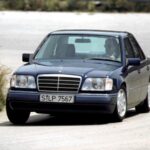
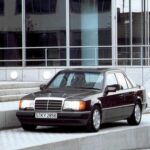
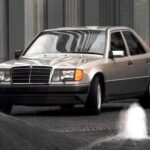
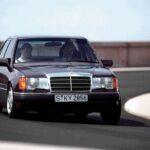
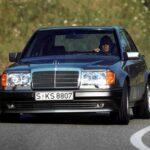
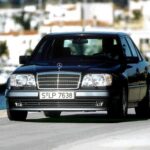
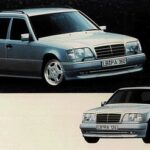
Within the changes taking place from 1993 all models of series 124 were stylistically actualised by reworking the body. Thus they were adapted to the other type ranges. The most conspicous characteristic of the modified models was the radiator grill changed in the shape of the S-class. Now the much smaller chrome frame was harmonically integrated into the engine bonnet. The Mercedes star - as in the S-class limousines - was on the bonnet. Also eye-catching were the changes at the lamp units. The front turn signal lamps had received colourless glass covers.
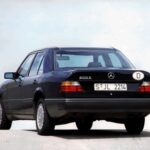
The rear lamps showed bi-chromatic covers, which in the area of the turn-signal and the reversing lamp had been uniformly stained in white-grey. The yellow turn signal lamp in the front and rear was produced by coloured bulbs. The bonnet lid was also redesigned. The pressure ridges at the upper side had been rounded. The area between the rear lamps, so far inclined to the front, was now parallel to the rear end. Furthermore, a chromed handle at the upper end of the licence number area replaced the uninterrupted plastic handle strip. Further changes were made at the wheels and the bumpers. Thus the steel disc wheels had new wheel trim caps in 6-hole design. The protective strip of the bumpers were now painted in the colour of the add-on parts. The protective strip of the rear bumpers had been prolonged to the wheel cutouts.
When the redesigned models were started to be sold in June 1993, a new nomenclature came into force which also applied for series 124. Analogous to the S-class and to the new C-class, the medium-size class now was called E-class. The designation of types now followed a modified system. Thus a letter documented the belonging to a class. It stood in front of a three-digit figure which continued to be based on the displacement. The ,E" for ,Einspritzmotor" (injection engine) could be dropped, since carburettor engines now belonged to the past. Codifying the obvious body variants by ,C" or ,D" was equally superfluous.
With the diesel powered models the former ,D" was replaced by ,Diesel" or ,Turbodiesel" after the figure. Thus the 300 D, according to the new designation, now became ,E 300 Diesel". The ,DIESEL"sign at the right on the boot lid could be omitted on demand, just as the whole type label.
With the introduction of the new nomenclature system the 400 E was renamed according to its actual displacement into E 420. Besides the designation of types, two technical details had also been changed. The standard equipment of the E 420 now also consisted of 16 inch all-aluminium wheels in 8-hole design with wide base wheels of dimension 215/55 ZR 16. At the front wheels the larger dimensioned brakes of the SL-model were installed.
In June 1995, two years of the last comprehensive model improvement, the E-class limousines of series 210 were introduced. They functioned as successors to series 124. The production of the ,old" E-class limousines was terminated a short time later, according to the type between June and August 1995. In March or April the 4MATIC-models as well as the E 500 had already stopped to be produced. A special position was taken by types E 250 Diesel and E 220. Their ckd-parts sets were still porduced till June 1996 and sent to Poona in India for assemly. All in all, within a period of more than 11 years, 2,058,777 limousines, 2,342 limousines with long wheel base and 6,398 chassis with partial bodies for special use had been produced.