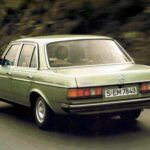
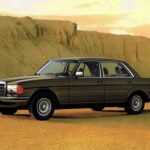
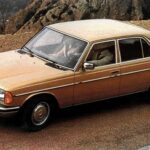
Limuzyny serii 123
Produkcja: 1975 - 1985

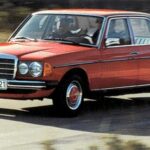
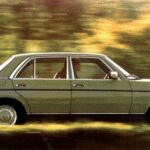

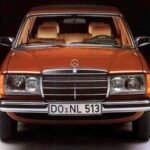
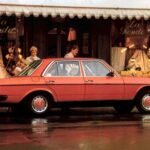
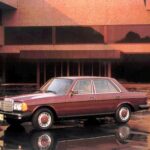
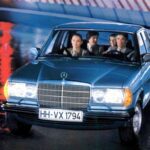
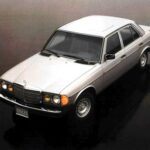
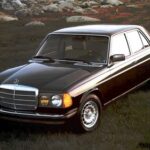
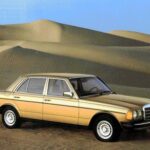
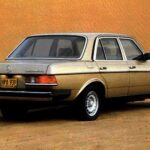
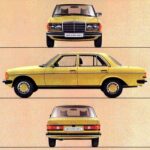
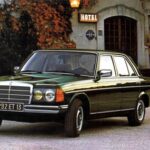
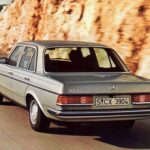
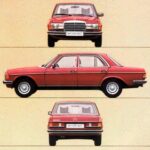
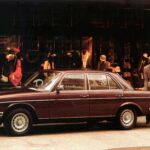

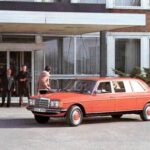



Typy
| Typ | Oznaczenie | Lata produkcji | Wyprodukowano |
|---|---|---|---|
| 200 D | W 123 D 20 | 07.75/02.76 - 04.85 | 378.138 |
| 220 D | W 123 D 22 | 07.75/02.76 - 03.79 | 56.736 |
| 240 D | W 123 D 24 | 07.75/02.76 - 11.85 | 448.986 limuzyn |
| 300 D | W 123 D 30 | 07.75/02.76 - 11.85 | 324.718 |
| 300 D turbodiesel | W 123 D 30 A | 04.81/08.81 - 08.85 | 75.261 |
| 200 | W 123 V 20 | 07.75/02.76 - 08.80 | 158.772 |
| 200 | W 123 V 20 | 10.79/08.80 - 11.85 | 217.315 |
| 230 | W 123 V 23 | 07.75/02.76 - 08.80 | 195.920 limuzyn |
| 230 E | W 123 E 23 | 10.79/07.80 - 11.85 | 245.588 limuzyn |
| 250 | W 123 V 25 | 07.75/04.76 - 12.85 | 114.796 |
| 280 | W 123 V 28 | 07.75/12.75 - 07.81 | 33.206 |
| 280 E | W 123 E 28 | 07.75/12.75 - 12.85 | 126.004 |
| 240 D long | V 123 D 24 | 09.77 - 11.85 | 3.841 limuzyn |
| 300 D long | V 123 D 30 | 09.77 - 11.85 | 4.679 limuzyn |
| 250 long | V 123 V 25 | 09.77 - 12.85 | 5.180 limuzyn |
| 240 D podwozie pod nadwozia specjalne | F 123 D 24 | 07.76 - 10.85 | 794 podwozi |
| 230 podwozie pod nadwozia specjalne | F 123 V 23 | 07.76 - 08.80 | 265 podwozi |
| 230 E podwozie pod nadwozia specjalne | F 123 E 23 | 07.80 - 10.85 | 294 podwozi |
| 240 D podwozie z wydłużonym rozstawem osi | VF 123 D 24 | 07.76 - 10.85 | 1.159 podwozi |
| 300 D podwozie z wydłużonym rozstawem osi | VF 123 D 30 | 07.76 - 10.85 | 2.602 podwozi |
| 250 podwozie z wydłużonym rozstawem osi | VF 123 V 25 | 07.76 - 10.85 | 2.888 podwozi |
| 280 E podwozie z wydłużonym rozstawem osi | VF 123 E 28 | 10.77 - 12.85 | 371 podwozi |
Historia
Historia tej serii nie jest jeszcze przetłumaczona; poniżej oryginał angielski.
In January 1976 the ,dash-eight"-models of the series W 114/5 were replaced by a totally reconstructed type range with the internal name W 123. The model family ranged from the 2,0 ltr.- 4 cyl.-Diesel with 55 PS to the 2,8 ltr.-6 cyl.-injection engine with 185 PS.
The new model range orientated itself to the S-class which had been produced for three and a half years. Thus the new medium-size type was also provided with a semi-trailing arm rear axle which had already been introduced with the ,dash-eight" models. Furthermore it was equipped with a twin control arm front suspension with zero steering offset. The chassis sub-frame of the preceding models was not necessary any more. All other construction details realised for the first time for safety reasons in the series 107 and 116 were of course transferred to the medium-size types. The most important improvements, in comparison to the preceding type range, was the even more stable security passenger cell with stiffened roof-frame structure, high-strength roof and door pillars as well as reinforced doors. The energy absorption of the front and rear deformation zone in the front and rear end was significantly increased by a controlled deformation capacity.
A technical novelty was the safety steering column, realised for the first time in the series 123. Steering aggregate and steering column tube were linked together by a corrugated metal tube. In case of a crash, this corrugated metal tube could buckle to the side. This was a further step to reduce the danger of the column tube invading the interior of the car.
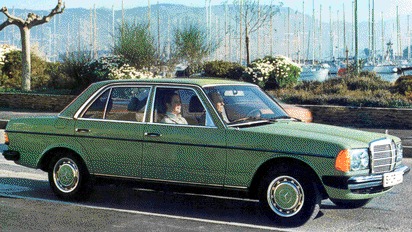
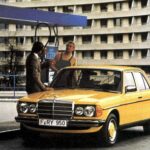
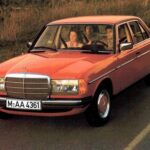
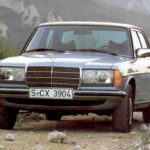
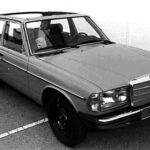
The various big round dual head lamps were a characteristic design of the new models. Next to the main head lamp, under a common lens, there was a smaller halogen fog lamp. Differing from that the two top models of the series, types 280 and 280 E, were provided with rectangular halogen wide-band head lamps. Externally both 2,8 ltr -types differed in three further points from their less powerful brothers. Type 280 as well as 280 E had a twin-scroll exhaust system - with twin end pipes, chromed air induction grill in front of the windscreen and an additional chrome strip under the rear lamps.
The range of engines was mostly taken over from the preceding models. The only exception was the type 250, which was not provided with the old 2,8 ltr.-aggregate M 130 any more, but with the newly constructed 2,5 ltr.-6 cyl.-engine.
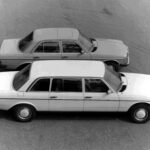
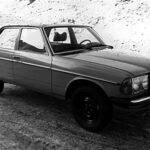
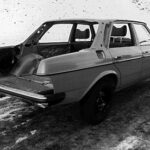
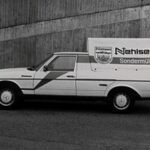
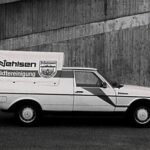
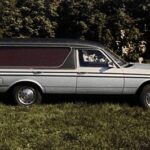
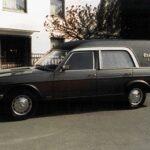
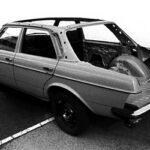
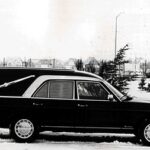
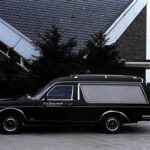
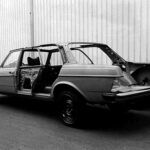
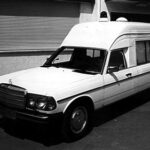
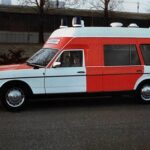
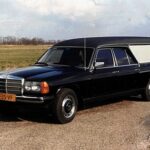
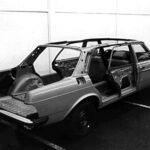
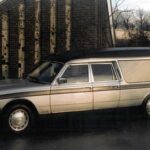
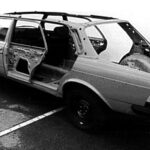
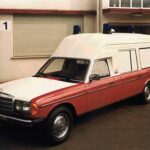
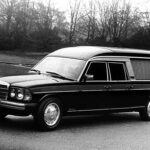
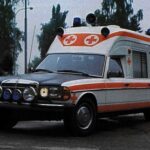
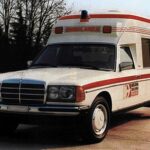
According to a long tradition, the limousines of the series 123 were also available as chassis with partial superstructure. They were completed to ambulances, estate cars and other special versions by carriage manufacturers at home and abroad. As in the preceding series, there was a variant with normal wheel base, the 240 D and 230, as well as a prolonged version with types 240 D, 300 D and 250. Ambulance constructions based on this chassis were mostly built at Binz in Lorch and at Miesen in Bonn. Among the best known producers of funeral cars on the basis W 123 were the superstructure plants Pollman in Bremen, Rappold in Wülfrath, Stolle in Hannover and Welsch in Mayen.
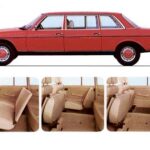
In the course of the year 1977 the type program of series 123 was extended by three new superstructure variants. First a stylistically very appealing coupe was presented at the Geneva car salon in March. It was available as 230 C, 280 C and 280 CE. Since August types 240 D, 300 D and 250 7/8-seater limousines with long wheel base were offered. As their predecessors from series 115 , they were mostly used by taxi and hired car enterprises in transfer services. Finally, in September, the fourth construction variant of series 123, the so-called T-limousine, was presented at the Frankfurt motor show IAA.
In the years 1978 to 1980 some changes took place in the range of engines of series 123. First, in April 1978, the power of 280 E was increased to 185 PS. Then 240 D was altered. From August onwards it mobilised 72 PS. In February 1979 even the least powerful type of the series, the 200 D, got 5 PS more. At the same time 220 D was taken out of the program. Finally, in September 1979, the power of the fife-cylinder Diesel engine in 300 D and of the six-cylinder carburettor engine in 250 was increased as well.
Nine months later, in June 1980, three new engines were introduced - one Diesel and one petrol-engined car. The 3,0 ltr.-5 cyl.-Diesel engine with exhaust-gas turbocharger, which had been used in the S-class export model 300 SD for almost two years, was now also available in the series 123. First, however, only for the T-limousine. A year later, in August 1981, the Turbo Diesel was also offered in the limousine and the coupe in the series 123. Both, however, were exclusively reserved for export to North America.
The two new petrol- engined cars, a 2,0 ltr.-carburettor engine with 109 PS and a 2,3 ltr.-injection engine with 136 PS, replaced the well proven 2,0 ltr.- and 2,3 ltr.-aggregates. Both engines, two different variants of the totally reconstructed four-cylinder inline engine M 102, were conceived for a slightly inclined installation in order to keep the overall height as low as possible. This set value was of special importance for use in future model generations. In spite of the power increase of 15 and 25 %, the fuel consumption could be reduced by around 10 %.
In July 1981 type 280 with carburettor engine was take out of the production. The 280 E with petrol injection remained unchanged in the program.
In September 1982, within an extensive model improvement package, all models of series 123 received rectangular wide-band head lamps, known from 280 and 280 E, modified air deflector profiles at the A-pillars as well as standard power steering, besides other numerous improvements. On demand ALS as well as airbag was available.
The production of type range 123 was stopped in November 1985, about a year after the series production of the succeeding type range 124 had started. Within ten years of production, almost 2,7 million cars had been built with all variants of superstructures. Among them were 2.375.440 limousines, 13.700 limousines with long wheel base and 8.373 chassis with special bodies.