„Skrzydlak” (Heckflosse), typy sześciocylindrowe (W 111, W 112)
Produkcja: 1959 - 1968
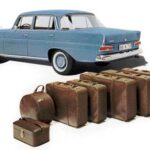
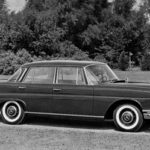
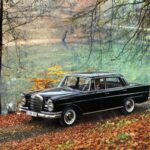
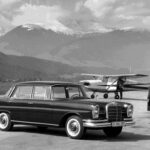
Typy
| Typ | Oznaczenie | Lata produkcji | Wyprodukowano |
|---|---|---|---|
| 220 b | W 111/1 | 05.59/08.59 - 08.65 | 69.688 limuzyn, 3 podwozi |
| 220 Sb | W 111/2 | 05.59/08.59 - 07.65 | 161.119 limuzyn |
| 220 SEb | W 111/3 | 08.59 - 08.65 | 66.086 limuzyn |
| 300 SE | W 112/3 | 04.61 - 07.65 | 5.202 limuzyn |
| 300 SE long | W 112/3 | 12.62/03.63 - 08.65 | 1.546 limuzyn |
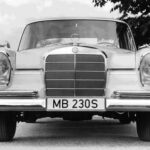
| 230 S | W 111 / I A | 07.65 - 01.68 | 40.766 limuzyn |
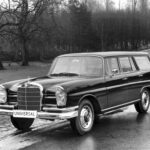
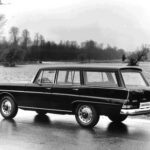
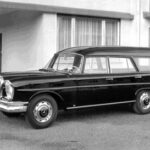
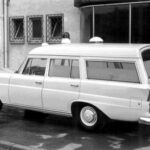
| 230 S Universal | W 111 / I A | 1966 - 1968 | brak osobnych danych |
| 230 S podwozie pod nadwozia specjalne | W 111 / I A | 07.65 - 01.68 | 341 podwozi |
Historia
Historia tej serii nie jest jeszcze przetłumaczona; poniżej oryginał angielski.
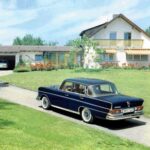
In August 1959, a profoundly revised passenger car programme was presented. According to the motto "The New Six Cylinder Model - A Class Of Its Own" Three completeley reconstructed models appeared as the successors of the old six cylinder types 219, 220 S and 220 SE. Except for some equipment details, the only difference between the new types 220 b, 220 Sb and 220 SEb, which internally were allocated to product line 111, were the different types of engines.
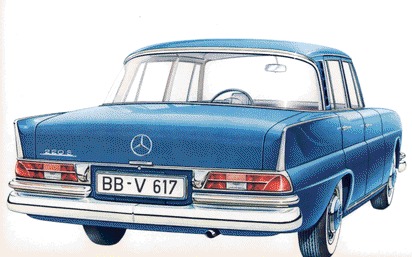
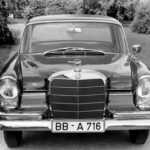
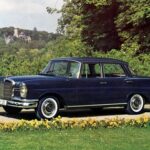
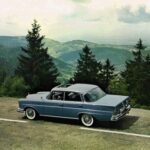
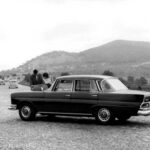
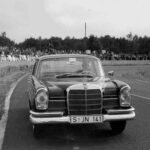
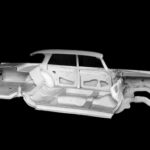
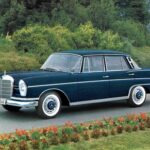
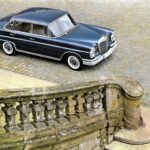
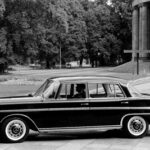
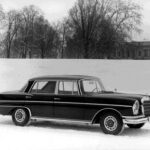
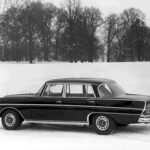
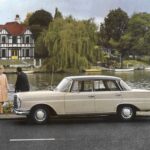
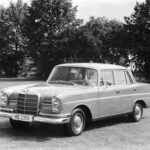
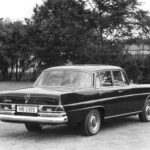
All three models had a spacious, elegant car body, distinguished by its salient feature the tailfin - a concession to the prevailing fashion, which was heavily influenced by the Americans at the time. It was this characteristic design, which later gave the name to a whole new generation of models; The types mentioned above are today generally referred to as ,Tailfin-models". The new models set the standard for passive safety; For the first time, the new Barényi-patent, a sturdy passenger cabin and crusher zones at the front and the rear, had been realised. Safety was the guiding principle in the design of the interior space; thus the new types were fitted with an upholstered dashboard with flexible and partially recessed instruments and a steering wheel with an upholstered centre-piece; another remarkable feature were new special door locks, which further improved driving safety.
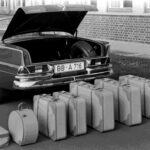
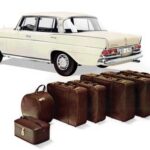
Eight features distinguished the exterior of the 220 b from its two sister models: except for the type labels, the 220 Sb and 220 SEb were identical in appearance; they had an additional chome trim on the right and the left of the radiator cover, a chrome air admission grid in front of the wind screen and chrome wheel boss caps. The differences at the rear of the car were more pronounced: The two models with the letter "S" in the type description had a chrome trim above the rear window, a decorative trim lining the rear edge of the boot lid, bigger taillights with integrated number plate illumination and additional corner elements between the taillights and the rear portion of the fender. The tailfins, officially described as ,arrow bars", had decorative chrome trims at the rear end and along the upper edge.
The engines were basically taken from the predecessor models and had only been slightly modified. All three units were fitted with a new valve drive and a steeper camshaft. The powerplant of the 220 b had only two carburettors and the injection engine of the 220 SEb hat been fitted with suction pipes. This resulted in a power increase of 4 and 5 bhp respectively.
Chassis and brakes were also basically carried over from the preceding types, the wheel suspension had clearly been worked upon, however. The concept of the "driving stool", which was introduced at the time of the ,pontoon"-Models, had been retained; However, its form had changed - it now consisted of a simple transversal bar with an elastic link to the frame floor at two points. the well-tried single joint cross shaft axle was fitted with a compensating spring, which was horizontally located above the pivot in order to ensure even distribution of axle load. The shock absorber in the front and the rear were situated as close to the wheels as possible which did not only result in a more effective dampening of vibration but also allowed better access.
During the time of production the brakes were modified twice: In April 1962 first the Types 220 Sb and 220 SEb were equipped with disk brakes at the front wheels. The same procedure was then applied to the 220 b which was moreover fitted with a servobrake that earlier had only been available at an extra cost. In the course of revision all three models were fitted with a divided brake system, which allowed safe braking, even if one brake circuit failed to function.
Like their predecessor models, the three types of product line 111 were available with the hydraulic automatic clutch "Hydrak", only until the beginning of 1962. A fully-fledged automatic gearbox, which had been developed for years until it was fit for serial production, was at first available for the 220 Seb only from April 1961. However, from August 1962 it could be ordered for an additional cost of 1400,- DM for the 220 b and 220 Sb, too. In contrast to the Borg-Warner automatic gearbox, which had been used from 1956 in the 300 c and from 1957 in the successor model 300 d, Daimler-Benz' own new construction did not have a torque converter but a hydraulic coupling, which had the advantage that power losses were low. The secondary 4-gear planetary drive consisted of two planetary sets, three lamella couplings and three belt brakes.
In August 1961, another top class model was presented with the 300 SE. With respect to its exterior and technical concept itclosely resembled the 220 SEb model but many technical specialities were included serially. Besides a 4=speed gear box and a new servobrake, which was also a new development, this was the first time a Mercedes-Benz passenger car was equipped with pneumatic damping , combining sports car qualities with a maximum of ride comfort.
Another innovatory feature of the model with the internal code name W 112 were the brakes: For the first time, a serially produced Mercedes-Benz passenger car had been fitted with dual-circuit brakes and disk brakes at the front and rear wheels.
The 3,0 liter-injection engine was based on the well-tried unit of the 300 d type, but had a light metal block with pushed-in sleeves reducing the units weight by ca. 40 kg. Carburation was still effected by intermittent suction pipe injection via a Bosch injection pump with two pistions. In January 1964 compression was minimally increased and the injection-pump now had six pistons. This increased engine power from 160 to 170 bhp.
The body of the 300 SE was basically identical with that of the 220 Seb, but had more decorative chrome elements. The most obvious distinguishing feature was a chrome trim, extending from headlights to taillights along the longitudinal bead; in addition the 300 SE had crome trims along the wheel arches and a broad chrome trim beneath the doors. The small "300 SE"-labels, which were integrated into the decorative trims on the C-pillars were less obvious. As an optional the 300 SE model could be ordered without the chrome trims.
In March 1963, the 300 SE lang [long] was presented at the Geneva Motoring Show, which was identical with the basis model 300 SE, but had a 100 mm longer wheel base. This additional space afforded more leg room in the rear of the cabin and it allowed for bigger rear doors. As an optional, the 300 SE lang lang was available with bulkhead and electric separating screen. Apart from their different measurements, the 300 SE and 300 SE lang models can be distinguished by an equipment detail: the long version has no decorative trim on the C=pillar, as deaeration ducts were located elsewhere, so that there were no apertures. Once the longer version came on the market, Both versions, the 300 SE as well as the 300 SE lang, were also available with 4=speed gearbox; this reduced the price by 1.400,- DM.
In Juny and August 1965, production of the 2,2 litre- and 3,0 litre-Types with "tailfin"-body was phased out. Successor models of the models 220 Sb, 220 SEb and 300 SE were the 250 S, 250 SE and 300 SE types, which belonged to a completely new generation of models. At the same time the 220 b was replaced by the 230 S type. Inspite of its unusual type description, the new model was basically not so new after all: the 230 S was almost the same as the 220 Sb, but was equipped with a revised engine. By boring open the proven 2,2 litre-aggregate and by increasing compression, engine power was boosted by 10 bhp up to 120 bhp. Another novel feature was the hydropneumatic compensating spring at the rear axle replacing the old coil spring, ensuring that, irrespective of loads, the level of the body remained the same. Except for a glance at the type label at the boot lid it was impossible to tell the 230 S and 220 Sb models apart from the outside.
Even though the 230 S was never intended for long-term production, 41.107 cars of this type were produced until January 1968, 341 of these served as chassis for special bodies. One special design of the 230 S type should be mentioned here: a station wagon, which was mounted by the Belgian car body maker IMA onto the chassis of the 230 S. Called "Typ 230 S Universal" it was distributed by the Daimler-Benz sales agency from August 1966.
Between 1959 and 1968 a total of 344.751 saloon cars and chassis of the product lines 111 and 112 were built at the production site in Sindelfingen.