Experimental vehicles C 111 - C 111 / IV
Production: 1969 - 1978
Types
| Type | Model | Production | Number produced |
|---|---|---|---|
| experimental car C 111 | 04.69 - 09.69 | 6 | |
| experimental car C 111 | 02.70 - 10.70 | 6 |
History
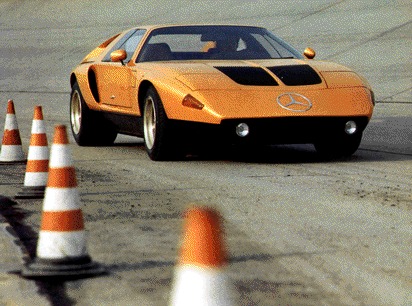
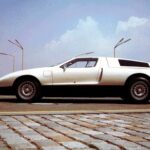
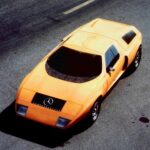
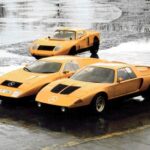
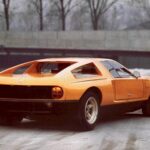
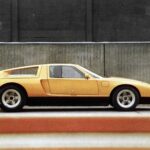
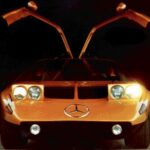
In September 1969, world wide attention focussed on the experimental vehicle C 111, which Daimler-Benz presented at the International Automobile Fair in Frankfurt. this "rolling test laboratory " was a highly conspicuous affair, with its extreme wedge-shaped body, wing doors that opened vertically and last but not least, its unusual colour, metallic orange - the original designation of colour was "weißherbst" [the name of a rosé wine from the South-West of Germany]. The technical innovations were not quite as obvious: the car body consisted of glass fibre reinforced plastic and was riveted and glued onto a steel framework; some technical features from racing cars were applied to the wheel suspension and the car was powered by a three-disc Wankel engine, which unleashed some 280 bhp and reached a maximum speed of 270 km/h, a remarkable feat at that time.
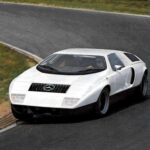
Only Six months later, a profoundly revised version of the experimental car was presented at the geneva Motoring show. The new C 111 had a more pleasing car body affording better vision and a roomier baggage compartment. It was powered by a four disc 350 bhp Wankel engine, which made for an excellent driving performance: it reached 100 km/h from a standstill in 4,9 Seconds and a top speed of 300 km/h. Although there were many orders and even blanc cheques for the car at the factory in Untertürkheim, the C 111 remained a purely experimental vehicle and was never serially produced.
The super sports car from Untertürkheim was a favourite object for exhibitions at home and abroad and for a long time guaranteed a high level of high publicity. Even after the Wankel engine had almost passed into oblivion, the C 111 was in the public lime light several times. In june 1976, in April 1978 and for the last time in May 1979, record speeds were achieved with the C 111 at the high speed circuit at Nardo in the South of italy, culminating in several absolute world records over various distances.
For the first two record drives, revised and more powerful versions of the 3,0 litre 5 cyl. Diesel engine were used: In 1976 engine power was boosted from 80 bhp to 190 bhp with the help of turbo chargers and some ancilliary measures. When in 1978 a charge cooler was added, the car produced 230 bhp. For the record drive in May 1979 a 4,5 litre V8 engine of serial production had been bored open accomodate to 4,8 litre and fitted with two KKK-turbo chargers. this increased engine power to 500 bhp at 6200 /rpm.
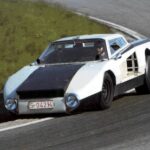
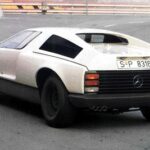
At the record drive in June 1976 the C 111=IID was still easily recognised as an C 111, as it had an only slightly modified exterior, compared to the model, which had been presented in 1970. The record cars of 1978 and 1979, had no longer much in common with the original C 111. Only the basic framework stayed the same: the new car had a wheel base, which had been extended by 100 mm as well as a reduced track gauge, 150 and 100 mm at the front and the rear respectively. The very long car body, that was now painted in silver, was designed exclusively on the basis of aerodynamic principles. After the experience with the car made at its record drive in 1978, but also in order to meet the higher requirements of the next race, the front section of the C 111=IV's car body was revised and fitted with two tailfins and front and rear spoilers. Four international and world records and one absolute circuit world record achieved with the the C 111=IV, even though this was never officially recognised, proved that these modifications had been very successful.