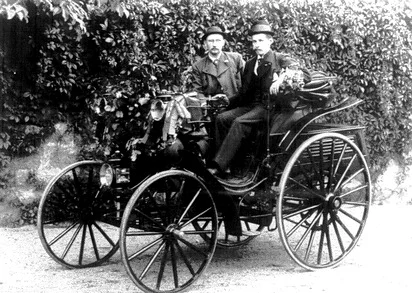
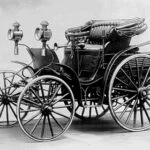
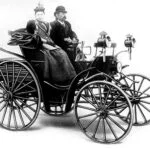
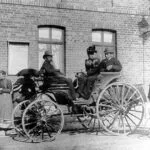
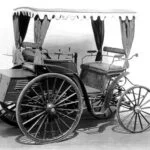
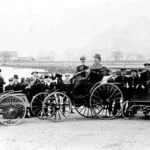
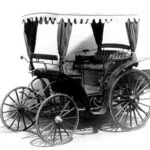
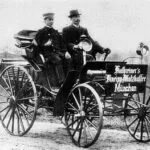
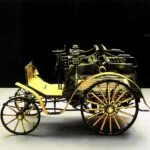
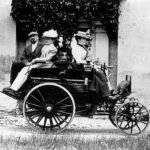
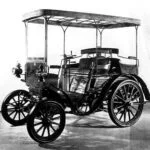
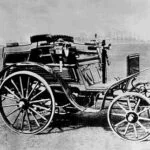
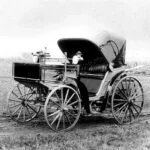
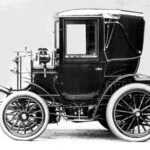
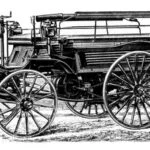
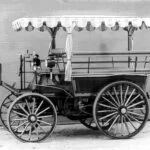
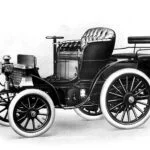
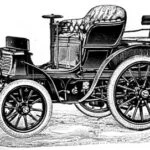
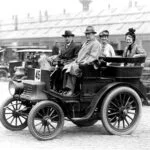
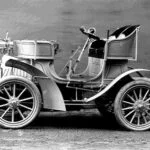
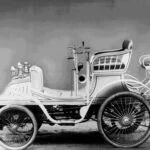
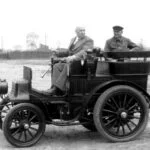
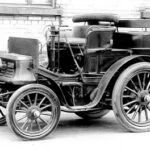
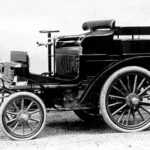
Patent Motor Car Benz "Victoria", "Vis-à-Vis" <5 hp>
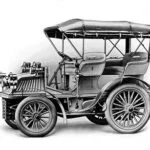
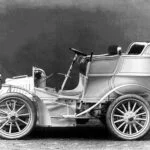
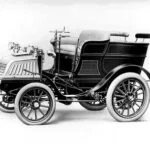
General
| Short name | Benz "Victoria", "Vis-à-Vis" <5 hp> |
|---|---|
| Name | Patent Motor Car Benz "Victoria", "Vis-à-Vis" <5 hp> |
| Production | 1895 - 1898 |
| Comments | four-wheeled motor carriage, 2 and 4 seats; driver's seat via rear axle |
| Prices | "Victoria" Mk. 4.100,- "Vis-à-Vis" Mk. 4.300,- "Phaeton" Mk. 4.950,- "Landauer" Mk. 6.150,- |
Dimensions and weights
| Wheelbase | 1650 mm |
|---|---|
| Track front/rear | 1300 mm |
| Length | 3200 mm |
| Width | 1650 mm |
| Height | 1750 mm (without cabriolet top) |
| Weight empty | depending on version: 650 - 780 kg |
Engine
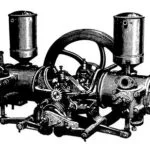
| Operating method | four-stroke |
|---|---|
| Configuration | rear, horizontal |
| No. of cylinders/configuration | 1 / horizontal, flywheel upright |
| Bore x stroke | 150 x 150 mm |
| Total displacement | 2650 ccm |
| Crankshaft bearings | 2 |
| Output | 5 hp at 600 /min |
| No. of valves/configuration | 1 suction valve (automatic), 1 exhaust valve / upright |
| Valve operation | via disc cam (only exhaust) |
| Mixture formation | Benz surface carburetter, since 1894 Benz float-type carburetter |
| Cooling | water / thermosiphon (evaporation cooling, since 1895 with condesor) |
| Lubrication | drop oiler on open crankgear |
Electrical system
| Electric system | 6 V |
|---|---|
| Starter motor | turning the flywheel, since 1896 starting crank |
| Ignition | electric high-voltage trembler ignition |
Fuel system
| Fuel tank | under the driver's seat |
|---|---|
| Fuel supply | gravity fuel feed |
Drivetrain and chassis
| Driven wheels | rear wheels |
|---|---|
| Power transmission | 2 flat belts from the engine to the countershaft with step discs and integrated differential; one chain from the countershaft to each of the rear wheels |
| Frame design | frameless wooden superstructure |
| Wheel suspension front | rigid axle |
| Wheel suspension rear | rigid axle |
| Suspension front | full-elliptic springs |
| Suspension rear | full-elliptic springs |
| Steering | king-pin steering; vertical steering column in center of car |
| Braking system | since 1896: outside band brake, effective on rear wheels |
| Parking brake | wood-pad brake, effictive on rear wheel tyres ; hillholder |
| Wheels | wood-spoked wheels |
| Tyres | solid-rubber tyres; rear wheels bis 1894 with iron tyres |
Gearbox and performance
| Gearbox | 2 forward gears, no reverse gear; from 1896: 3 forw., 1 rev. |
|---|---|
| Shifting | 2 or 4 gear shifts under caster crank |
| Clutch | no |
| Type of gearbox | Two-stage flat belt gear; resp. added planet gear |
| Maximum speed | approx. 25 km/h |
| Fuel consumption | 20 - 25 l |